We’re back with the third installment of Wildermyth Wednesday! It’s been a little while, and I’m eager to get back on the ball, so let’s move right in to the screenshots for this week.
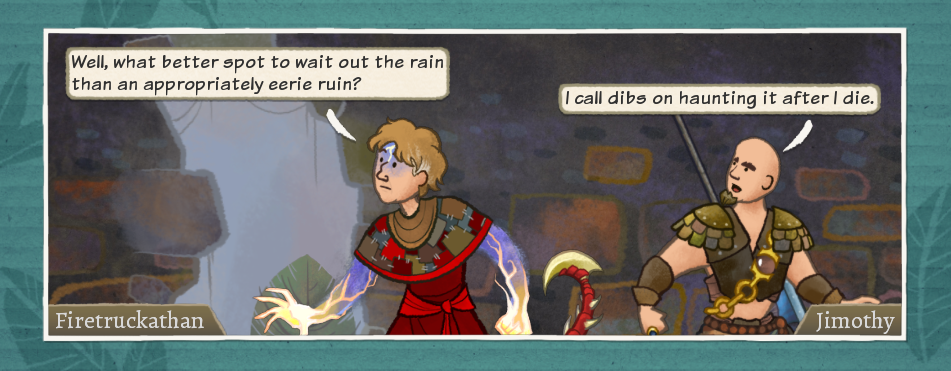
Firetruckathan & Jimothy Find A Ruin
In the above image, two of my long-time characters, Firetruckathan Broad and Jimothy Jackalitis, have found an “appropriately eerie ruin.” They’re both funny characters who appear frequently in the multiplayer games I’ve mentioned in previous posts, with Jimothy having the highest possible “Goofball” rating that a character can have. That’s why he’s seen here calling dibs on haunting this ruin after he dies.
Eleni & Warietta Reunite
There’s not a ton going on here in these two screenshots, but I really like how Wildermyth contains events like this one. While interactions like this are simple on the surface, they show the connection between your characters in a way that feels true to real life human interactions.
Anyways, here is Eleni Heartthrob, a mystic of some reknown, and Warietta Wobinson, a pretty deadly hunter in her own right, are joking with one another as they see each other for the first time in awhile.
…I do think Eleni’s maybe being a bit unfair to her friend here, whose hair is not exactly “standard.”
Selected Passages from Rowdy
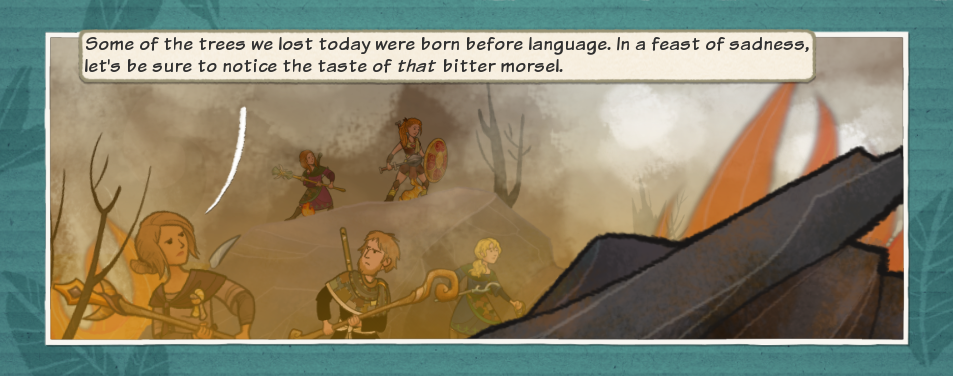
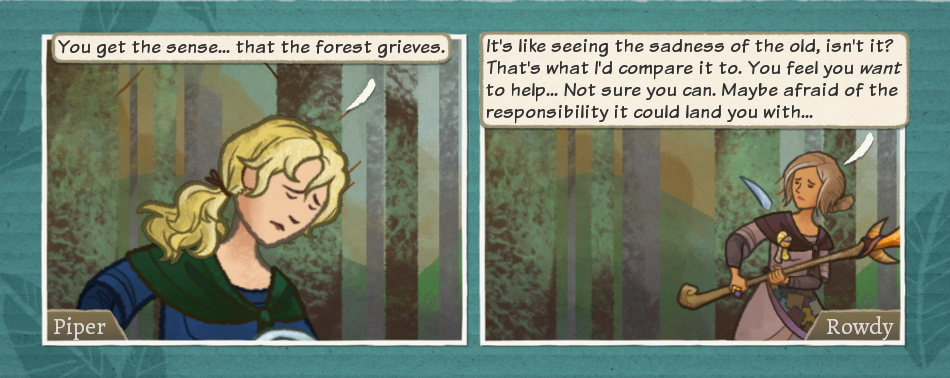
Rowdy Aylen is a poet, and I don’t remember how she came to be named Rowdy. Was it the game generating a somewhat goofy name? Was it me deciding that, for some reason, I was going to give that name a hilariously-dramatic character who speaks as if she’s playing a part in a somewhat overbaked play?
Regardless of how she came to be Rowdy, here she is! In the first shot, she’s reminding her recently-triumphant-in-battle friends that we just lost some really old trees (fair, but a kinda silly thing to say before something like “oh friends, I’m glad we all made it through the fight alive!”). In the second one, she takes Piper Pippinwiffle Jr.’s observation about the forest grieving to be a prompt for her latest verse. I need to remember to actually feature her in a campaign again soon.
Artir & Taylor Sing Together
Mystics in love. Taylor Timethief and Artir Cranberrysauce singing together was very cute. I have to think they both noticed each other’s hair at some point before they started being a thing.
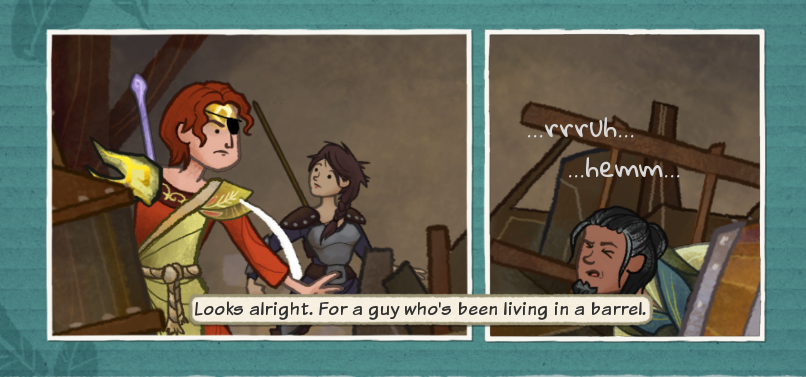
Xanfar the Magnificient Passes Judgment Upon a Guy
I don’t think any further explanation is required here.
And we’re back! For those of you who missed part one, Wildermyth Wednesday is a regular series involving screenshots collected from the Worldwalker Games 2021 release. Wildermyth is an RPG with turn-based combat that does an amazing job of making the story focus on the characters which you, the player, recruit/create. It’s fun! You might consider trying it sometime!
Without further adieu:
The Adventures of Zanbert
There are plenty of opportunities to transform characters in Wildermyth. And often, in my playthroughs, I won’t end up deciding to have a character undergo a transformation–sometimes it doesn’t fit with my previous idea of who that character is or what role they’re playing, etc.
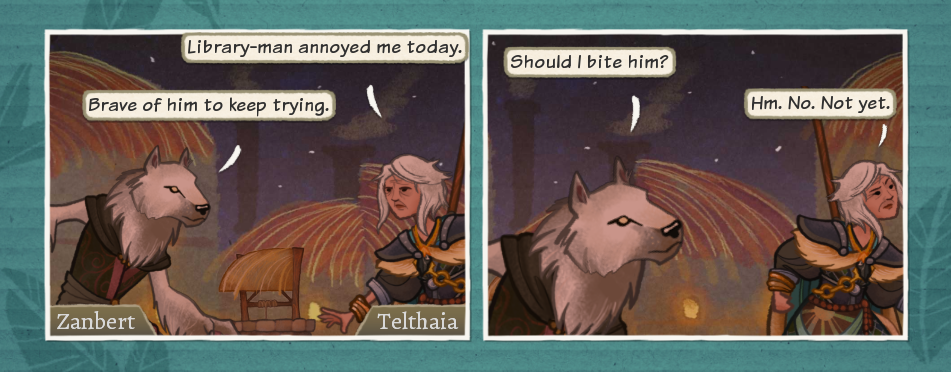
Zanbert Gravetether, however, is an example of how transformation–he’s become a wolfman, as you can see–sometimes can enhance the personality of a character and make them more memorable within one’s Wildermyth canon. Above, he’s offering to bite someone on behalf of his mystic friend, Telthaia Truffleworth.
And in this one, he’s delivering a devastating zinger group of bandits that he and the other party members have encountered. Note that this is from a different campaign, and he’s younger, which is why his coat is gray rather than white. But wow, “Maybe that should inform your decisions?” That’s cold, Zanbert.
Annnnd the less said about this one, the better! We’ll move on to a different set of characters now:
Deepists Or Cheesemongers?
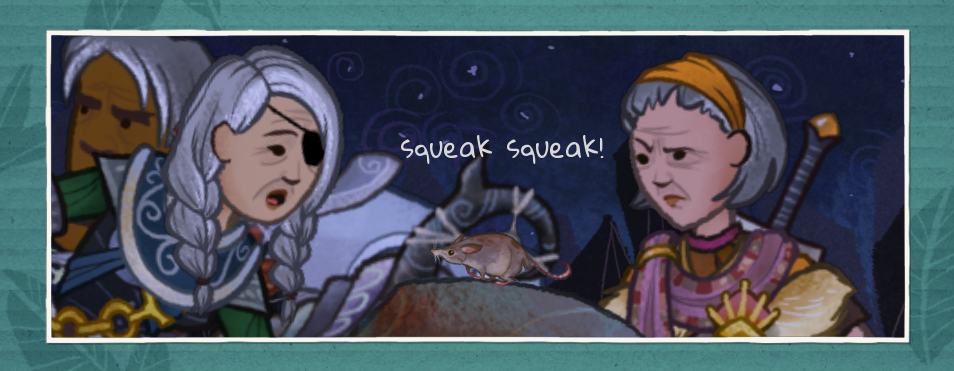
In the first one, above, two of our heroes, Ebbriana Sherbert (right) and Gretchen Greatwasp, are hearing testimony from a helpful mouse regarding the location of enemy forces. Grady Day (who somewhat escaped having as silly a name as the others in this campaign) is in the background.
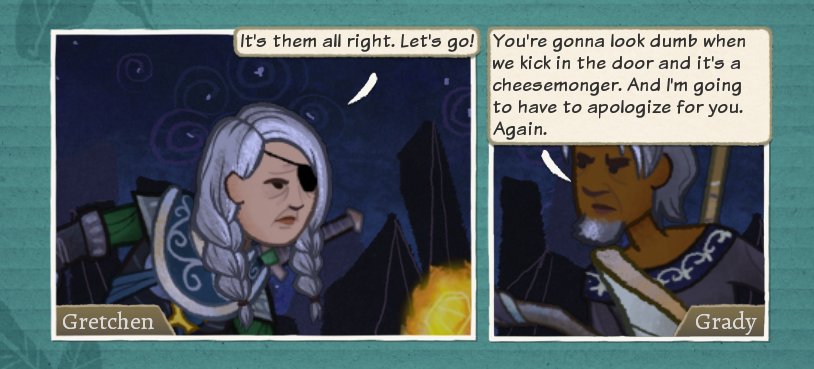
And here we see that Grady is somewhat skeptical of Gretchen taking the mouse’s word. Suggesting that rather than the Deepist cult that they’re fighting, the mouse might have just gotten excited about a cheesemonger being located nearby.
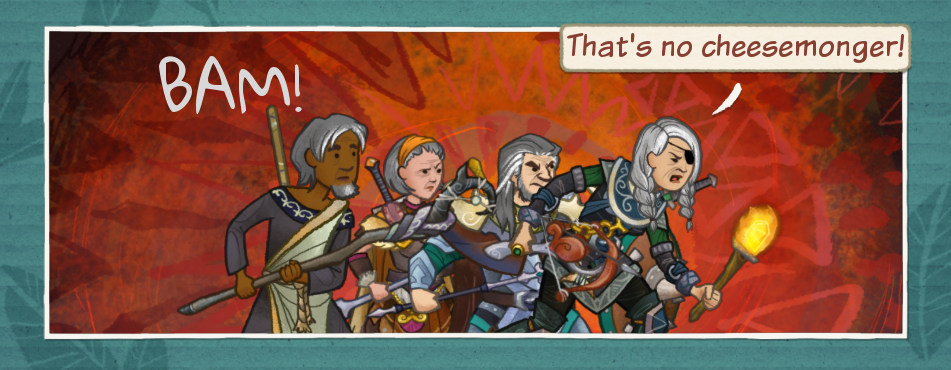
…but then the party–including the previously unseen Cobb Vas Sky (second from right)–charges in, to discover that, well, it’s NOT a cheesemonger. It was the Deepists after all. Rodents are right more often than you’d think.
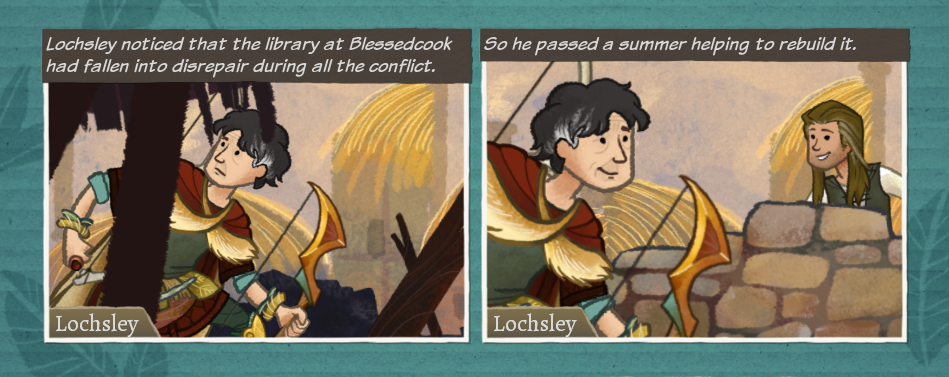
“Library Lochsley”
Each character in Wildermyth possesses personality traits, measured on a scale from 1-99. The two strongest traits go a long way towards determining their reactions to certain situations and their dialogue in certain interactions. To use an example from last Wildermyth Wednesday, Domino Wildelance–the mystic who threw himself down into an underground cavern to protect his daughter–is referred to as a “Goofish Leader” because his strongest personality trait is “leader,” and his second strongest is “goofball.”
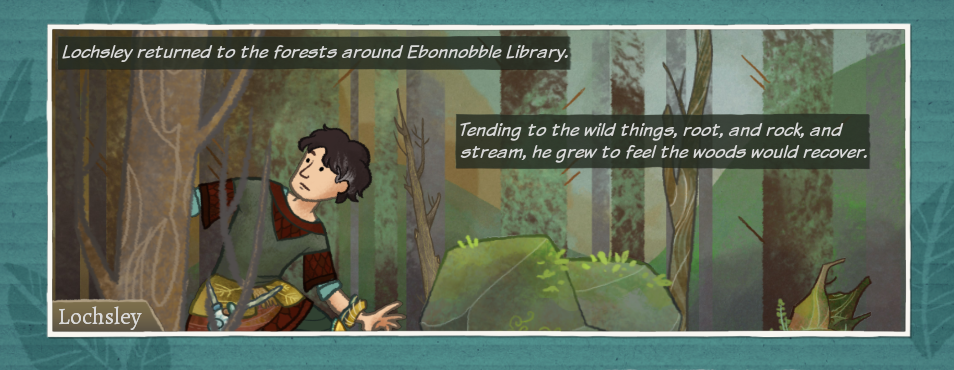
Lochsley Kynestrange? Well, he’s a Bookish Poet.
A real man of mystery. It’s hard to tell what he’s passionate about.
Wildermyth, a 2021 Worldwalker Games release, is a game I’ve played a lot over the last couple years. It’s a party-based fantasy RPG with turn-based combat, seamlessly woven into a story structure that shines the spotlight on the characters the player has created and recruited. While other squad management games (the rebooted XCOM and the first Darkest Dungeon, to name a couple) allow you to customize your charges but don’t do much to establish them as three-dimensional characters, Wildermyth takes the ball and runs in a character-focused direction. The game possesses a pretty impressive array of campaign options, but the characters you create and how they interact with each other are the meat of the story. And if you play enough if it, you may very well end up with your own cast of thousands.
So! Wildermyth Wednesday is a weekly feature that I hope to keep publishing as part of updating this blog more often again. As kindly suggested by one of the other contributors, this feature will include a handful of screenshots from the many I’ve collected, and a short explanation for why I picked each. Along the way, maybe this’ll spark your interest, dear reader, in playing the game. Or maybe you’ll just like observing the large cast of characters who’ve accumulated over umpteen playthroughs. Either way, without further adieu, below is the first of this week’s shots:
Skinny’s Battlecry
Wildermyth multiplayer is a joyful, if sometimes the slightest bit buggy, experience. The above is from the latest campaign that one of my siblings and I played which centered around fighting back a tide of the robots-with-bones creatures known as the Morthagi. We created these three as our starting characters: Aisling Starchaser is the blue-haired mystic on the right, Prim Weedwater is the hunter in the middle (my sister’s creation), and Skinny Conlock is the warrior who is struggling with the assignment of yelling something impressive as a battle cry.
The Freaky Freecairn Freedom Fighters, Years Later
And this one is from later in that same campaign. In fact, several years later. Aisling, Prim, and Skinny have all been at the fight for years, and have been joined by Prim’s son, Cabbage, and another warrior (left of Aisling) named Pip Rust. The five of them are accompanied by two allies whose names I won’t mention due to spoilers.
And yes, the name of the group for this campaign was, in fact, the Freaky Freecairn Freedom Fighters. And yes, we did pick the name.
Two Unfortunate Rivalries
The two screenshots below show two different rivalries forming during a custom campaign. The campaign set-up is designed to take a couple of your existing Legacy Heroes and generate each of them a younger sibling. I did this for Stornbaron and Kika because they were both older characters in my legacy who still didn’t have any family members. I thought it would be nice.
…and then they both formed rivalries with each other’s younger siblings. I was a little miffed over this happening. It wound up being a fun playthrough, nonetheless.
Domino Dives In, Daddily
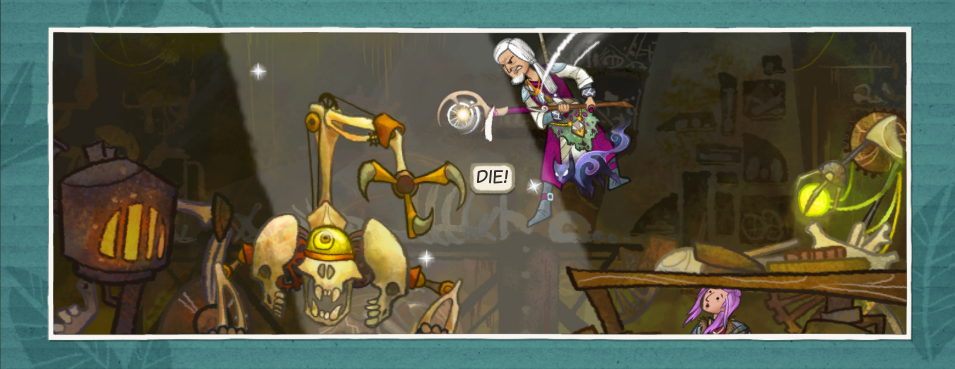
This last one is also one where our characters are fighting the Morthagi. In this event, Lirielle Wildelance fell through the ground into the Morthagi workshop, and is now hiding under the table while she waits for back-up. One of the options I had at this point was to allow her father, Domino Wildelance, to jump in after her. I decided to have him do that, since it’s in character with him being protective of the other members of the group. That’d be why there’s an old mystic and his shadow cat flying downwards towards a bone-and-metal monster. Domino’s not about to let his daughter fight the bad guys off alone.
Pink is one of their family colors according to my head canon.
Next!
We’ll return next Wednesday with a new set. In the meantime, maybe I’ll actually finish one of these reviews that’s been on the backburner for awhile now.
In the comics (and graphic novel) industry, particularly the Superhero “sub-genre” that headlines for the Big Two (DC & Marvel), there’s what’s called a “Crossover Event.” For those of you not hip to this (which is fine), it’s the outwardly incredibly simple idea of mushing multiple characters from the same universe into the same story line. DC has Justice League. Marvel has The Avengers. You probably don’t need more examples.
I feel like it’s being accepted more and more that–unless you’re a younger fan, in which case bless you and perhaps don’t read this–these actually tend to kind of suck. The equation seems like it should be incredibly simple: you take characters that are fun, you put them in the same series, and it’s even more fun. Fun plus fun plus fun should equal three funs, right? Well, as a number of better writers than myself have illustrated, this usually isn’t the case. As detailed in this excellent essay, Crossover Events and Renumberings actually tend to be a “jumping off point” for readers when it comes to the Big Two. Marvel especially.
In addition to the in-depth and heartrendingly accurate breakdown of how messed up the direct market in comics are, I’d also like to throw out what I think is the practical problem in terms of writing these types of stories. You’re basically taking the main characters from a bunch of different series and having them all on the page or on the screen at the same time. When this leads to witty exchanges of views, co-operation, and fun over the span of a short period of time, you can get the rare success of this type of subgenre. For all of the grief I’ll give Marvel and even with how disenchanted I’ve been with superhero flicks in general, I’ll concede that the first Avengers movie is a good example of how this can be done in a non-infuriatingly bland way.
“With our power combined, we aspire to be a lot less boring than your typical Supes-Mashup!”
However, I think part of what explains why that worked is that two hours and thirty minutes of the same MCU characters being on-screen together is a relatively short period of time, where as a result the writers don’t have to worry as much about things the clash of the different series tones. It’s when these endeavors have to explain themselves in a little more detail (such as in the comics runs or in, say, a Netflix series) that some of the contradictions become more obvious. Part another way: “The Avengers” is basically everyone in the MCU having a two-and-a-half-hour cameo, and it’s way easier to nail that format.
When the characters who normally headline their own series come together for a longer period of time, the problems tend “pop out” right in front of your face. A lot of these characters have different goals/ethics, which would be more interesting if it weren’t for the fact that the stories usually detail them all coming together to fight for a common cause. Each of their own individual series has its own tone–Jessica Jones’s tenacity in the face of an oppressive shit world, Luke Cage’s sizzling energy as the series has him deal with corruption in the community he loves, Daredevil’s split between getting things done within the system and concurrently asking the question of whether the system is too broken, Iron Fist being an excellent reason to not cast Finn Jones as White Buddhist Batman–and it’s hell of a thing to try to let these spill into each other without accidentally muting them all. And the villains have tended to be either ridiculous (even by Supervillain standards) or just a pathetically lame foil to let the Superheroes stand out more.
Understand, I’m not saying every crossover ever has failed to take this all into account, but basically all of them have had to deal with the above challenges. And I can tell you, personally, as someone who owns too many DC trade paperbacks, that the above challenges and the fact that writers tend to shrink from them a bit is the reason I own all of Scott Snyder’s Batman run for the New 52, and approximately zero of the Justice League trades.
But back to Marvel’s Defenders. As you probably guessed by now, I don’t think it’s really up to snuff. I know there are people who’ve become pretty disillusioned with the Netflix Marvel series in general, but I’m not among their number; I liked Jessica Jones, Luke Cage, and Daredevil quite a lot, and I tolerated Iron Fist. I really did think there was a significant chance for The Defenders to break through the tape that way too many crossovers seem to wrap themselves in. Sadly, it’s really impossible for me to say that it did. And I really wanted to like this, if not love it.
Less than the sum of its parts, sadly.
But it really is the same old stuff. There are a couple of neat hooks where the characters are brought together in not totally contrived ways, and otherwise it’s that weird feeling where you never really get to spend enough time with any one of these characters (except for Iron Fist, whose mentor is cooler than him, but hey), and the overall plot rushes into focus fast enough that the reasons that they’re able to hash out their differences and co-operate feel cardboard. Maybe if I didn’t enjoy three out of the four of these series so much, this wouldn’t bother me as much. But that’s sort of the opposite of the point here, isn’t it? I was watching Defenders because I did like the other series.
There’s two exchanges that sum up the entire series for me. For one, it’s one of those scenes where the writers threw two characters into conflict for contrived enough reasons that it’s just hard to sit through (see also: Arya and Sansa Stark’s conflict from Season 7 of Game of Thrones), so it’s got a strike against it right off the bat. Secondly, Knight, a detective, is questioning Jones. Now, I know Superhero stories are never really going to break from the whole “cops are generally good with a few bad apples” perspective so I’m willing to give that a bit of a pass, especially since the police in Luke Cage weren’t exactly heroic-it’s really just Knight, as his friend, who stands out as trying to do the right thing. But I’m also really not sure why Knight would be treating a known associate of Cage as hostile. She even goes as far as to give Jones shit for offing Kilgrave at the end of Jessica Jones Season 1. Kilgrave had raped Jones (and other women as well), so this is downright wince-worthy stuff.
Jones’s reaction is to basically continue the dialogue while acting annoyed, and it’s really hard to figure out why doesn’t have a stronger reaction to this. It’s even harder to figure out why the writers thought this needed to be in the series at all. This scene could’ve easily been an interesting back-and-forth between characters who’re trying to do the right thing and taking vastly different approaches, and instead it ends up with an unconvincingly vanilla conflict that’s derived from Knight saying something uncharacteristically awful. Add some incredibly forced dialogue into the mix and it’s just pretty much the perfect example of things not fitting together and god-awful writing turning it into a total mess.
There’s another one where Luke Cage calls out Iron Fist for being an entitled prick, which is a scene that’d work approximately one thousand percent better if Finn Jones wasn’t a wooden actor, Iron Fist wasn’t an entitled prick, and if Cage’s decision to call him out on this had a bit more of a lead-up to it. On that last point, I’m all for Luke Cage yelling at Iron Fist, but the scene managed to be rushed, robbed of impact, and once again display how Jones really, really cannot act all that much at the same time. If you replaced him with a board with a slightly constipated expression on it, Mike Colter’s words would’ve had more impact.
But seriously, I know I’ve made it more than clear that I don’t care for Jones’s acting or the Iron Fist in general, but the weakness of that series combined with his central role in this one is an issue. When Cage goes after him, the viewer might be inclined to take his side, but a better constructed Iron Fist character with a better actor would’ve given that scene an appropriate amount of nuance, prompting there to be a range of different opinions that could arise from viewing it, like “Cage is right, but Rand clearly didn’t get his point across” or “Cage came on too strong, Rand doesn’t get what’s going on yet” in addition to (what seems like the only possible conclusion unless you’re just the hardest-core Iron Fist fan in the world) “Cage is right and let’s move on.” It takes a scene that should be thought-provoking, and turns it into something much less.
This looks awesome.
I could go on–the villains are pretty wooden aside from a Madame Gao reappearance–and the show manages to take eight episodes and make it feel like it both should’ve been shorter (for reasons I mentioned above re: The Avengers) and longer. But instead I’d rather just focus on the picture above.
In the end, I do keep coming back to this and other shots from the promo material, and being annoyed by how cool some of these look, too. Because once the series got going, it was impossible for me to not wonder exactly where the gritty, “it’s just a bunch of friends hanging out trying to deal with the impossible burdens of life” feel of these actually went. Because hell, that is so something the viewer can relate to. There’s another one where they all look like they’ve been hanging out all night and are beginning to feel slightly hung over. These are also pretty cool in their own way, and a series that had found a way tap into that feel of them all genuinely bonding probably would’ve also been the same kind of series that actually managed to figure out how to balance its characters and tone better.
As it is, we got something that played it way too safe and ends up feeling like it could be a show about any four slightly bland superheroes, rather than two whose personas (and actors) carry the hell out of their own series and one who’s the only blind criminal defense lawyer that I’m aware of in superhero canon.
You can enjoy parts of this series, and if you watched the others, you’re probably going to watch this one. But if you were expecting “awesome+awesome+cool+Iron Fist = more awesome” (or some variation on that equation), I don’t really think that’s what you’ve got here.
In space, no one can hear you complain inside your helmet.
So, there’s been a lot of pre-release noise in regard to Mass Effect: Andromeda. The fourth entry in the series had caught some flak from more than a few people based on silly-looking animations and a few other things that are equally hard to summarize or care about. For this series, this isn’t anything new, of course.
However, there was enough of it out there that, when EA/Bioware added the ability to play up to a certain point (and keep the progress once the game was officially released) for $5 to access the game via Origin Insider (which also gives me a 10% off coupon if I choose to buy the game, for a whopping $2 of savings in total!), I jumped on the opportunity. A
Full disclosure – I really enjoyed the original trilogy, despite its warts. I’d go as far as to say its one of the few series that exists that I feel game-love for. I also liked ME3 and ME1 better than ME2.
I’m not someone who reviews games as my livelihood and Game Mechanics is just a group of friends posting whenever the need to write on entertainment hits, so I have very little experience in writing about a game before the actual release. To help flesh things out for people who’re on the fence about pre-ordering vs. waiting for reviews vs. waiting for a sale vs. skipping this title vs. hiding inside a bunker and refusing to interact with Bioware-produced media ever again, I put it out there that I was “buying in” to the first ten hours, and gathered questions that my pals on a couple different social media platforms had about it. Those appear after my initial summary, which is below. Hope this helps!
~
Mass Effect: Andromeda launches the player back into the same universe as the first three games, only this time you’re playing as Pathfinder Pick-A-Name Ryder rather than Commander Pick-A-Name Shepard. Oh, and also, once you set up your Ryder, you learn that you’re part of the Andromeda Initiative, a private venture to cross “dark space” from the Milky Way to the Andromeda Galaxy. And also it’s 600 years later than the end of ME3, because apparently that’s how long it takes for your “Ark” ship to get from one galaxy to another. And you’ve been woken up and, inexplicably, the first thing they give you is coffee which anyone could tell you is a terrible choice for the first thing you ingest directly out of 600 years of cryostasis.
It’s worth noting that, as with the vast, vast majority of other video games, we’re limited to the gender binary in constructing our Ryder in Mass Effect: Andromeda. If you play a guy, you’ll have a gal twin sister, and vice versa. I didn’t really expect anything else, but it does seem something that developers should try harder with in the future, since having the option to build your character from the ground-up is basically an acknowledgment that playing a specific type of character isn’t really key to the way you interact with the game.
Anyway, so you’re part of the AI, and your Ark has exited dark space and collided with a bunch of space-glowy-crap that has a name that’s easily less convincing than “space-glowy-crap,” and naturally some of the tutorial is you figuring out the basic mechanics in order to help your shipmates fix a messed-up widget or two.
Did I say you were the “Pathfinder”? Just kidding, it’s your Dad. On a related note, a Pathfinder is apparently the person in charge of finding a new world to live on (a “Golden World” according to the ME:A jargon). I’m not really sure exactly what the credentials for this position involve, seeing as once your dad does the typical Disney parental thing and croaks in order to make sure you live through an encounter with lizard-people, you’re elevated to the position based on his dying proclamation. You then discover that your part of the expedition has actually been the most fortunate, probably, as none of the other Arks–Turian, Salarian, Asari (all names that’ll be familiar if you’ve played one of the first three games, and if not…they’re fellow aliens from the Milky Way)–have shown up yet, and the “Nexus” space station that was sent ahead of you to give you all a home base is behind schedule, has already had to fight off a rebellion (and exile some people, which is definitely going to come up again), is low on resources, and sustained losses to its leadership team to the point where the replacements are now sort of politically at each other’s throats over who has control over what part of the expedition. Hooray!
If this makes it sound like you’re a bunch of Space Incompetents from Planet Dipshit, the good news is that doesn’t really wreck the experience so much as actually add something! For one thing, this seems pretty much how a billionaire-funded private space enterprise would go – just look at SpaceX. For another, being thrown into a situation where the leadership structure is in tatters and nothing seems to be going the way anyone planned is actually pretty interesting because it bucks the original Mass Effect story arc practice where Shepard was learning about systems already in place that previously hadn’t involved humans or the Systems Alliance, and replaces it with you being relied upon as one of the people to make chicken salad out of chicken shit as Pathfinder Ryder.
Once Cradwap Ryder–sadly, I was one character short of “Cradwapper” but no one should care about that–had an appropriately terrifying vision, neon hair (and let it be said that the character customization is quite fun, as always), and had been confirmed as the Mass Effect: Andromeda equivalent of a Vanguard, we were off to the races. Well, okay, technically that all happened before the Ryder’s father died in a selfless attempt to inject pre-fabricated feelings into the opening couple levels.
The classes have different names and allow for a little more variation within soldiery-types than other Mass Effect games, but otherwise they should seem pretty familiar to veterans of the series. For new people, you’re going to be picking a class that gives your character some ability in Typical Soldiery Shooty Things, Using Drones & Robots To Shoot Things, or Using Your Augmented Brain To Toss People In The Air And Cackle, or some combination of the three. I picked the one that’s a combination of the first and last, because I haven’t yet been able to come up with a good answer to the question, “what is a bad thing about being able to charge into people and headbutt them with brainpower, yet also still being able to operate the gun you are holding?”
And so Cradwap Ryder was off to a couple different places. The first couple levels gave me a chance to get a feel for combat, which is fine, and the interface, which is also, again, fine. The AI of the enemies/your two companions has come under fire as one of the things that needs work whenever Bioware gets around to patching things, and I’ll say that that’s a valid complaint (if overblown like virtually every complaint). Ryder and I had very little trouble with disposing with most enemy combatants on Normal difficulty, up until we got to the point where it’s a big enough fight in a relatively open area that you sort of need your allies to contribute.
At that point, I was sort of glaring sidelong at my idiot comrades and cursing under my breath the same way I do when I’m stuck with an Overwatch team that doesn’t appear to comprehend that at least going through the motions of Shooting What Is In Front Of You And Is Also Shooting You would be extremely helpful to allow me to get us through this fight. I had one other companion–I’d give you the names, but I feel like it’s relevant that none of them made much of an impression during my time with the game, so you’ll have to look it up–who had similar abilities to my character, which was helpful about half the way time. The other half, she went headlong into the middle of four enemies and had to be revived (the typical mechanic where you crouch near your friend’s broken, shattered body and hit “E” until they’re Just Fine After All!) or I had to fight with just me and Idiot No. 2 for the rest of the battle.
To be fair, when it was a more tunnelly battle with lots of cover, my allies did fine. But this engagement, in the second area of the final mission that the Origin Access buys you, uh, access to, you’re fighting around and inside a multi-leveled base, ostensibly an attempt at a sort of evaluation colony before it was attacked by another non-native race called the Kett. And this basically broke my teammates and thus was the only time I died other than my usual handful of deaths involving idiotically walking off a cliff.
In regard to the combat overall, I say “fine” because, while not on the same level of futility as the friendly AI, the enemy AI also makes some puzzling decisions. Such as reinforcements dropping out of a shuttle onto a roof and then bumping into each other in their attempts to be the first one to jump down to the surface and combat The Mighty Cradwap And His Two Moron Disciples. I also say “fine” rather than “great,” because, while I had no problem with the shooting mechanics or using the powers, the Kett, which make up your enemies in the first couple levels, gave the combat a distinctly Mass Effect 1’s Downside feel where it seems like the game has two simultaneous ideas going that are at war with each other: 1. it wants this to be an epic third-person cover-based battle 2. inexplicably gives you a foe type or two whose entire purpose is to try and get into melee range, which are just numerous enough that the first idea doesn’t really pan out. Thus far, the inventory system–related to the combat for obvious reasons–feels similarly Mass Effect 1, in that it’s a mess (as ME1’s kinda was).
However, the added mobility options are a plus, as you’ve also been given the options to “dodge” or use your kinda-jump-jets to quickly relocate, so while this overall feel is way less fluid than the combat in ME3 or even ME2, what you’re left with is something that feels very much like the pieces are in place–especially with the idea that you’ll get more than just your Headbutt and Shoot A Bolt Of Hurty Stuff abilities later on–for plenty of fun. And said ability to jump/boost in any direction sort of helps offset the cover system – the game assures you you’ll automatically take over when you approach a viable object with your gun out, and this works about as inconsistently as you might think if you were given such vague instructions.
Anyway, fun! I certainly did have some, I just wish I could’ve upped my character past Level 5 to see what lies beyond. I don’t think it helped that it’s sort of impossible to see the basic Kett enemies as anything other than “the guys you fight because you have to fight someone to learn to fight.”
Speaking of seeing, that was another thing that merits mentioning. I’d say the proper critique for Mass Effect: Andromeda’s graphics is that they’re not an improvement, from what I’ve seen, on Mass Effect 3, and there are indeed a few more rough edges than in the previous two games. The stuff about the facial animations and character models are both pretty overblown, unless you somehow expected Bioware to suddenly stop having a problem getting the eyes and teeth to look 100% like they go with the skin. I didn’t, so whatever – I wish they’d get a little better at this, but truly this isn’t near the middle of my complaints list.
And I suppose that’s the ultimate conclusion here. A lot of the complaints about Mass Effect: Andromeda are valid, and there’s the unshakable idea for me that this game absolutely should have more polish than it does given all the time that Bioware’s had to craft the first chapter in the new story arc of this series–it’s a little bizarre to be making my way through levels with the simultaneous feelings that the game’s mechanics give the potential for the most dynamic combat/movement in the series, while on the other hand the actual product thus far is something closer to ME1’s combat only not that good. The trial, also, really doesn’t get us deep enough into levelling for me to look at a bunch of different abilities/tech tree stuff. To say nothing of the element of choice and decisions affecting the storyline and such, a key component of RPGing that understandably hadn’t appeared in the early going.
But overall, despite these caveats and the fact that I really haven’t gotten to know any of the characters yet for any of them to be particularly memorable, I can’t deny that I was pretty much instantly sucked back into the universe. The setting is interesting, the potential conflicts within Nexus leadership and beyond, in the Helios Cluster, are both compelling. None of the characters seem potential-less, just the course of a handful of plot missions didn’t give me much chance to get to know them. The combat really doe seem like it could be significantly. better once I reach level 10 or so. If the question is, “were you, given your own background as a ME fan, convinced you should buy it?” the answer is yes. It’s with with the caveat that I’m not as happy as I thought I’d be, but it’s a yes.
However, a lot of you had other questions, which I’ve done my best to answer below:
Q: Is it even any good? Mass Effect is my favorite series ever, just didn’t have time to play the trial. Worried it will suck.
It feels to me like it’ll be somewhere in the considerable gray territory where it’ll get a fair amount of deserved flak, while still being worth playing (especially if you’ve like the first three). I say that as someone who, also, loves the Mass Effect series despite its warts.
I will say I definitely found parts of it to be lacking, but I also had no trouble getting into the game during my trial time.
What’s that all add up to? For me, it means I’ll skip the digital deluxe stuff and just go for the standard edition.
Q: Can I/should I play this if I couldn’t quite get into ME1?
A: I’m going to say no, not right now. If you like the idea of getting into the series but had a hard time getting into the first, the best starting point is likely to try ME2 – ME2 revamped the gameplay in a way that’s a significant break from the first, so there’s a good chance that if you didn’t get into the first all that much that the second’s reboot of that part of the gameplay will resonate with you. Plus, that way you get some of the sense of build-up to ME3’s climax (assuming you like ME2 enough to keep going).
The weird thing about this game is that, in terms of its graphics style, the first couple missions’ aesthetic, and the combat, this feels like it’s got similar warts to ME1. So if that wasn’t your jam to the point where you couldn’t hold your nose and play through it, I don’t recommend starting here.
Q: re the character model animations as frequently silly as people have made them out to be? Bioware’s animation always had awkward moments, but it sounds like they are far more apparent this time around.
A: As with a lot of the pre-release buzz going around about the game’s issues, it’s both 1. an actual annoyance in some instance 2. horrendously overblown by the Leap To Conclusions section of the internet. The fact is that there’s always been some silly shit in Bioware games, and in regard to facial animations it’s really just more of the same. Disappointing that it wasn’t more fine-tuned? I guess. But the only thing that was remotely glaring in my experience was the example below.
Q: How goofy are the walk/running cycles for your character?
The one place I’ll say that I found it annoying was when the running animation try to realistically portray the way people move when you’ve been running in one direction, and then quickly switch directions – this animation feels like it was built for wide-open areas, so when it kicks it right next to a wall or a box, it’s made my Andromeda Initiative Pathfinder look like a frigging jackass who’s trying to show off the stupidest ways he can run without falling. Practically, the issue is that sometimes this leads to me getting hung up on said object (and sometimes getting shot).
Q: Also, how does the switching between 4 favorite power load outs feel? Especially mid-battle?
The interface itself is definitely not a problem in battle – it feels pretty intuitive, even as the layout reminds me more of the first game than the second or third. I didn’t get too deep into the tech trees, obviously, but it’s not on my list of complaints.
Q: Does the ass-car known as the Mako return?
A: No, but it had a child with a hummer that you’ll get to drive. I have no idea what to say about how it handles, as I suspect it’s going to be rather polarizing like its parent-vehicle.
Q: Has Bioware delved further into non-hetero/queer relationship options for the main character/supporting cast?
A: This is a great question, which I wish I’d have time to reach. Unfortunately, with trial time only taking me through the opening sequence, boarding of the Nexus, and going to a couple cruddy planets, I pretty obviously hadn’t hit the downtime in-between plot missions yet where you have an opportunity to get to know your squadmates better.
Q: Also, can the main character still inflate their ass and float around on the ceiling to avoid gun battles?
No, but it’s pretty easy to accidentally jump-jet into an area that you don’t fit in very well, and then get shot like a jackass. I accomplished this a couple times underneath the base structures in the second area (the one where my squadmates freaked the hell out). The game could’ve used a lot more polish in terms of hints about “can I go under there without my character suddenly becoming afraid of walking.”
Q: Are the shoes fancy enough?
A: Not during my gameplay, but my character is still only Level 5 – there is ample potential for fancier shoes to make an appearance.
Q: Great game or greatest game?
A: Sort of doubt it’s either one, but it’s a lot of fun to be back in this game world. Remains to be seen if it makes more of a long-term impression than that, or if the Andromeda adventures end up playing Hobbit Trilogy (fun and worth your time, but stretched thin and mainly coasting on the success of the previous trilogy) to the first three games’ Lord of the Rings (very good), but the good news is that I don’t think it sucks!
Note: I wrote this awhile ago and then forgot to post it. Since I’ve having some issues getting my newest post onto wordpress, read this in the meantime. You might laugh. If you don’t keep in mind that it was funnier back when people were actually seeing the movie. I promise.
~
Zach Snyder: ready, we’re going to have Batman and Superman fight.
Superman: Okay
Batman: I’m magic
~
(Somewhere that is not America)
Person of Color No.1: I am pretty sure I am a terrorist
Person of Color No. 2: yes. Look, we have captured Amy Adams!
POC1: Why would they even hire her for this movie? She’s going to be totally wasted on this film.
Amy Adams as Lois: Save me, Superman! In The Year 2016, Save Me! A Grown-Ass Woman!
POC2: Agreed. Also, I have been crushed.
(Superman saves her)
Lois: Bae
Superman: Let us leave now.
(White terrorists kill black terrorists, because white people are even better at terrorism!)
~
(Later)
First Black Person Who Isn’t A Terrorist: Hi
Reporter: Are You A Terrorist?!
~
(Clark Kent and Bruce Wayne meet at a Lex Luthor event)
Lex Luthor: Hello, I am Jesse Eisenberg playing Lex Luthor. Some people actually praised me for how I played this part, because every other character in this movie acts as if they just watched a puppy die! However, I am still fucking obnoxious!
Reviewers: What spirit! He’s actually having fun in this movie!
Crowd at Manor: Yay or something!
Audience: I’m actually at this movie.
Kent (to Wayne): Batman’s a jerk.
Wayne (to Kent): Don’t you write for a shitty newspaper?
Kent: Yeah-No, we just like to write about Superman.
Wayne: Superman’s a jerk.
Kent: No, he’s great.
Wayne: Well, Batman’s great.
Kent: He Is Not
Wayne: My, this sure is a battle of wits.
Kent: Okay I agree this establishes how smart and affluent we are.
Zach Snyder & No One Else: Yessssssss!
~
(Later, at the Senate)
Senator: People died where you were.
Superman: Uh…
Senator: You are overstepping your bounds. I’m going to talk to Lex Luthor about this.
Audience: Does…anyone…in this…movie…think?
~
Senator: let’s stop Superman, who I think might be too powerful.
Lex Luthor: ah, Superman. What a prick. He answers to no one. I, on the other hand, head up a multinational corporation that clearly has questionable ethics standards and functions essentially outside the law as well.
Senator: Hmm, no actually I think we shouldn’t talk.
Lex Luthor: No I think we should.
Senator: Huh, okay.
(Later)
Senator: No, we should not talk.
Lex Luthor: He could she possibly get that I’m evil? Ah well, time to blow her up.
~
Snyder: Okay what’s the most offensive, awful event I could shoehorn into this plotline where the Senator is blow up?
Scriptwriter: Uh…maybe a disabled veteran could blow himself up inside a senatorial hearing?
Snyder: Brilliant.
Scriptwriter: that was supposed to be hypothetical
Snyder: Hypowhat? Anyway, put it in.
~
Senator: Superman, you’re doing things.
Superman: Yes I am.
(Explosion)
Superman: Shit, I’m getting blamed for this by total morons, aren’t I?
~
Batman: Wow, I definitely blame Superman for that.
Alfred: Sir, shouldn’t you have children by now?
Batman: I can’t do math, you see.
Alfred: Yes, sir.
Batman: and thus, I have to kill him.
Audience: oh…c’mon, really?
~
Lex Luthor: I have two brilliant plans. I’m obnoxious.
Audience: How much screentime does he get?
General Zod: Is…is there a reason I’m still not decomposed or…?
Lex Luthor: I’m going to make you into Doomsday using my blood and an alien spacecraft that for some goddamn reason listens to me, okay?
General Zod: Excellent, there are no plot holes here. I am also dead and therefore cannot disagree.
~
Lex Luthor: Superman, I hate you.
Superman: Okay.
Lex Luthor: I have your mom captive.
Superman: Hey, that sucks. I am displaying emotion for the first time in the movie.
Lex Luthor: Fight Batman.
Superman: What?
Lex Luthor: (blowhard speech about gods and men and bullshit)
Superman: Okay, okay I’ll fight him leave me alone.
Lex Luthor: if you don’t fight him, your mom dies.
Superman: Okay, I think I already agreed to fight him.
~
(Batman and Superman begin to fight)
Superman: Hello, we shouldn’t fight because–
(Batman attempts to kill him, Superman is unfazed)
Superman: Ahem. We shouldn’t fight because–
(Batman attempts to kill him again, Superman is again unfazed)
Superman: that’s weird. Thought you didn’t like guns? Anyway–
Batman: You’re a threat to this world! You damaged my penis–I mean, my car!
(Batman starts fight again, Superman kicks his ass)
Batman: Owwwww
Superman: shit, I forgot what I was going to say! Somehow, against all odds, I’m not fucking mentioning that I’m only fighting you because of Lex Luthor!
Batman: I only have two kryptonite-grenades for some reason, but I just remembered I made those so HA take that.
(Batman throws kryptonite grenade, it hurts Superman. Batman kicks Superman’s ass)
Superman: Owwwww
Batman: I’m going to stick a spear through your chest!
Superman: No don’t, my mom!
Batman: Fucking what?
Lois Lane: His mom’s name is Martha.
Batman: Good point. That’s the same name as my mom’s. Let’s save your mom. And not fight.
Superman: Not fight each other.
Batman: Yes, that.
~
(Batman saves Superman’s mom)
Batman: I’m a friend of your son’s.
Martha: (actual funny line that way too many people who had left the theater already missed)
~
Lex Luthor: Look! I’m doing things evilly and I made Doomsday
Doomsday: HRUUUUUUUUGH
Superman: Imma punch that
(Superman does so)
Doomsday: HRUUUUUUUUUUUUUUUGH.
(Doomsday sends Superman flying a bit)
Wonder Woman: I’m here and I’m going to kick ass!
Superman: wait, who is she?
Batman: the one character in this movie who didn’t have enough screen-time to be wrecked.
Doomsday: HRUUUUUUUUUUUUUUUGH!
Batman: okay, the one character with actual lines.
Superman: Ah. Well I’m going to get stab it with a spear made of shit that kills me.
Lois: Here’s the spear that will kill Doomsday and you, but if you want I could just run this over to Batman or Wonder Woman and one of them could kill Doomsday.
Superman: nope, got this.
Audience: OH COME ON
Wonder Woman: well actually, I’ve got Doomsday tied up here so you probably have time to give that spear to–
(Superman stabs Doomsday)
Wonder Woman: Okay, whatever.
Doomsday: fuck you I mean HRUUUUUUUUUUUUUUUUUUUUUUUUUUUUUGH
(Doomsday stabs Superman)
Batman: What a heroic and symbolic sacrifice.
Wonder Woman: We could call an ambulance?
Lois: I was dating Superman.
~
(two funerals happen at once)
Super Director Zach Snyder: SEE, THIS REPRESENTS THAT SUPERMAN WAS BOTH A PERSON AND A SUPERHERO. TWO SEPARATE PEOPLE WHO MEANT TWO SEPARATE THINGS TO
~
Everyone: Welp, he’s dead. Yep. Dead. He was great.
Batman: Can anyone–anyone?!–please explain how the hell this movie wasn’t based on the rather obvious yet still interesting fact that Superman and I are both heroes, but Superman kills people and I don’t? Anyone? No?
I’ve been on one of those kicks recently where, on the single-player side, I play a lot of one game in a row, then move onto the next (rather than more-fragmented version of my gaming existence, where I started up six different games and play each for an average of five minutes), and marathon that one for a bit.
Largely because my brain’s been in a sort of all-or-nothing place when it comes to entertainment lately, this has meant that each of these games I’ve been into of late has done the bare minimum of holding my attention. So bear that in mind, given that the blurbs on each are fairly distinct. Anyways, without further adieu:
Don’t Starve Together
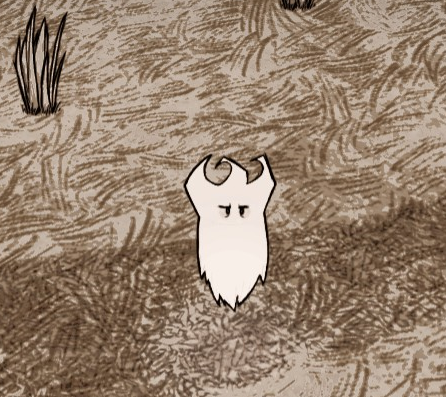
This is me.
How much I have to sell this one probably has a lot to do with how much you’ve heard about/played “Don’t Starve,” the original single-player version of which arrived in April of 2013. “Don’t Starve Together” is the co-op version of that cartoon survival simulator, and it mixes a cutesy, well-animated appearance with a rock-solid premise which is best described as “delaying the inevitable for as long as possible.”
Of course, you might want to take into account that I’m speaking largely of what happens when you play with me, as I don’t consider myself particularly good at this game, but still.
The basic premise–a key part of that is made clear in the title–is to survive in the wild. To do so, you’ll need to keep your health up, your stomach full, and your sanity intact. Once you have the basics of making campfires (to keep you warm, ward off the creepy things that come out at night, and cook your food), finding food, and collecting things you need to make certain items (a garland of flowers serves as a shield against losing sanity, for example, and building a “science machine” allows you to to do science), you’ll be able to survive long enough to yell at your friends about finding the Beefalo Herd to hide among to ward off the Hounds.
If you die–see above–you can be revived, though it takes a fair amount of effort from your party members to do so. Since the game world is pretty much constantly trying to kill you–don’t stay out at night, stay away from basically anything that isn’t your friends or a rabbit–you will die at some point. At this point, my favorite activity is haunting the vegetables my teammates have planted to make them grow faster. Unfortunately, my presence as a ghost is a drag on their sanity. Such a conundrum.
Anyways, playing the single player version of “Don’t Starve” will give you a pretty good idea of the mechanics. That said, even though it’s a fun game in itself, “Don’t Starve Together” feels like such a natural progression into a better, more-expletive filled (“where the @$## are you guys? I accidentally aggro’d the Beefalo again!”) version of the game that in retrospect it’s hard to believe it’s only existed since April of 2016.
The only caveat I’d mention before starting your own journey, which, invariably, will end in cold hard reality, is that “Don’t Starve Together” is a standalone expansion, so with both it and “Don’t Starve” being $15 each–and both being recommended–you might want to wait on the next sale (depending on whether or not survival games are your usual cup of tea, or if you’re trying something like this for the first time). That said, you really could do worse with those $30, and I frequently have.
Watch_Dogs
Speaking of “I’ve done worse with $30,” it’s Watch Underscore Dogs! It’s rare that I actually manage to sink 15 hours into a game and still manage to end up agreeing with most of the criticisms leveled at it, but here we are.
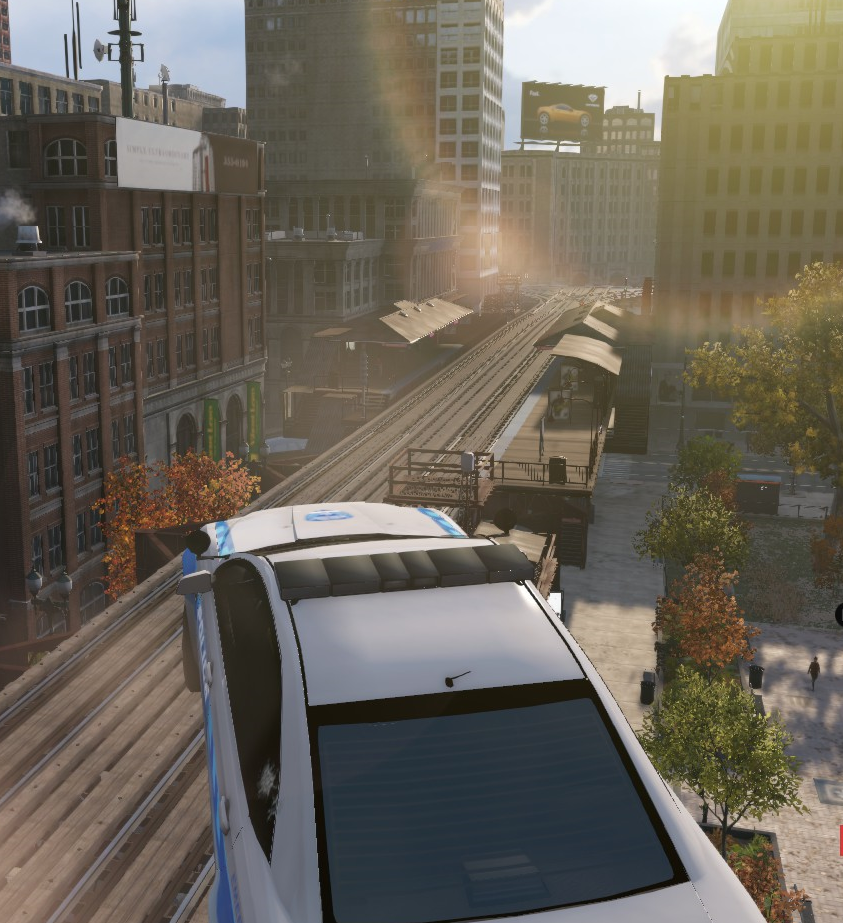
“Bring that back, NOW! That boat matches my outfit!”
Did I mention the sort of “all-or-nothing” kick I’ve been on has lent itself to Open World games? Well, it has. I just finished Mafia III recently, re-installed LA Noire the other day, and I’m currently making my way through Sleep Dogs’s Definitive Edition (I’ll be posting on each of these down the line). I would like to report that all of those are better games than the first Watch_Dogs. You probably already knew this or suspected it based on some of the reviews of Watch Underscore Dogs when it was first released. Well, it’s true. I could try to clumsily complain about the storyline/protagonist myself, or I could highlight this quote from a Finnish game reviewer who absolutely nailed it:
Ubisoft’s flagship title has a really, really repulsive protagonist. The entire storyline feels like it was cranked out of a automated story generator
Full stop. That’s pretty much all you need to hear on the subject. Open worlders don’t need a likable, or even compelling protagonist in order to succeed, given good gameplay. But Watch_Dogs open world is, well, fine, and nothing to write home about. And the storyline allegedly contains five acts and, honestly, with how little effort appears to have gone into making anything about it interesting, it seems to be daring the player to give a fuck.
And I truly do not a give fuck, you see.
There’s a perfectly playable game here, and I logged 15 hours in it before I finally just had to hit the breaks. I’ll give Watch_Dogs credit for feeling marginally distinctive from other “Drive Around A City And Be Rude” games based on Grumpy Protagonist’s ability to hack into things. The first couple times you hack a system in Kind Of Chicago, it’s legitimately cool. And I never stopped being amused by hacking traffic lights to cause NPCs to smash their cars together, though this is no small part because of how hard it was for me to find something else distinctive from other games (or fun).
The thing is, everyone’s made one of these games now, so it’s not quite enough to turn out the same template as GTA without giving me more of a reason to care about playing this version of said template. For some people, perhaps the hacking is enough of a reason. Or you’ll find something else about this game more enjoyable than I did. However, as it stands, it’s not something I can recommend going back and digging up, especially since the second one is out and apparently better.
(NOTE on that linked review: it shouldn’t be taken as gospel, but the reviewer for RPS basically felt the same as I do about Watch_Dogs 1, so his input on Watch_Dogs 2 being a better game seems relevant)
(NOTE 2: since the second game is out, the first one’s price is likely to drop, so…you can probably find out yourself if you enjoy this game more than I did)
Tyranny
I still haven’t gotten to the more-heralded Obsidian/Paradox venture, Pillars of Eternity, and the fact that the two companies teaming up for this game is pretty much directly why.
This is a screenshot of the game’s logo, because it turns out I’m terrible at remembering to screenshot RPGs. Uh, I mean, I…uh…wanted to avoid spoilers.
So in Tyranny, you’re trying to make your own way in a harsh world, and you work for bad people. No, stop! Don’t leave! I know you’re thinking, “Gus, that is exactly like real life, why would I want to play a game like that?”
But! In RPG form, it turns out this is actually quite entertaining. Well, that and the fact that you possess a great deal of influence over the way things turn out in “Tyranny.” Wow yep I should not have used that real-life analogy, this blurb is already about four times as depressing as I meant it to be (rise up, my fellow proles!).
Anyhow, Tyranny takes the cRPG premise and turns it on its head, and that’s really the main appeal. Kyros, a sort of Sauron-like overlord type, has taken over almost the entire setting world. You’re playing an agent of the “Archon of Justice,” a hooded fellow named Tunon, and you’re sent to one of the recently conquered parts of Kyros’s realm to oversee the putting down of a local rebellion.
Essentially, you’re middle management in an Evil Empire, rather than necessarily being The Hero We Need.
The lore for the world is well done, and, without wanting to get too much into spoilers, the decisions you make do matter for the plot quite a bit. It’s initially shown as a conflict between two different factions in Kyros’s army–suggesting that you need to pick a side between the two–but things branch out quite a bit. Lest I forget, there’s a cool sequence at the beginning where you pick how your character was involved in the Conquest of the locals (you can also skip this, but I don’t know why you would), and there is the first of many examples of how your decisions and the plot are interwoven. There are a significant number of times where, based on something your character did two years ago (in game time), the local will react in a way that either gives you more options or forces you to purse an avenue you might have wanted to avoid in the name of Doing You Job.
If that last part sounds like “railroading,” what I mean is that you actually get a feel for being someone who’s got to make tough decisions or they’ll have Tunon & Kyros calling them to the office. There’s a delicate balance sometimes in this game of trying to avoid pissing everyone off-Tyranny keeps track of your relations with different factions and characters, and part of the weight of your decisions is the impact on you when you realize you’ve hit a point where you can’t please everyone.
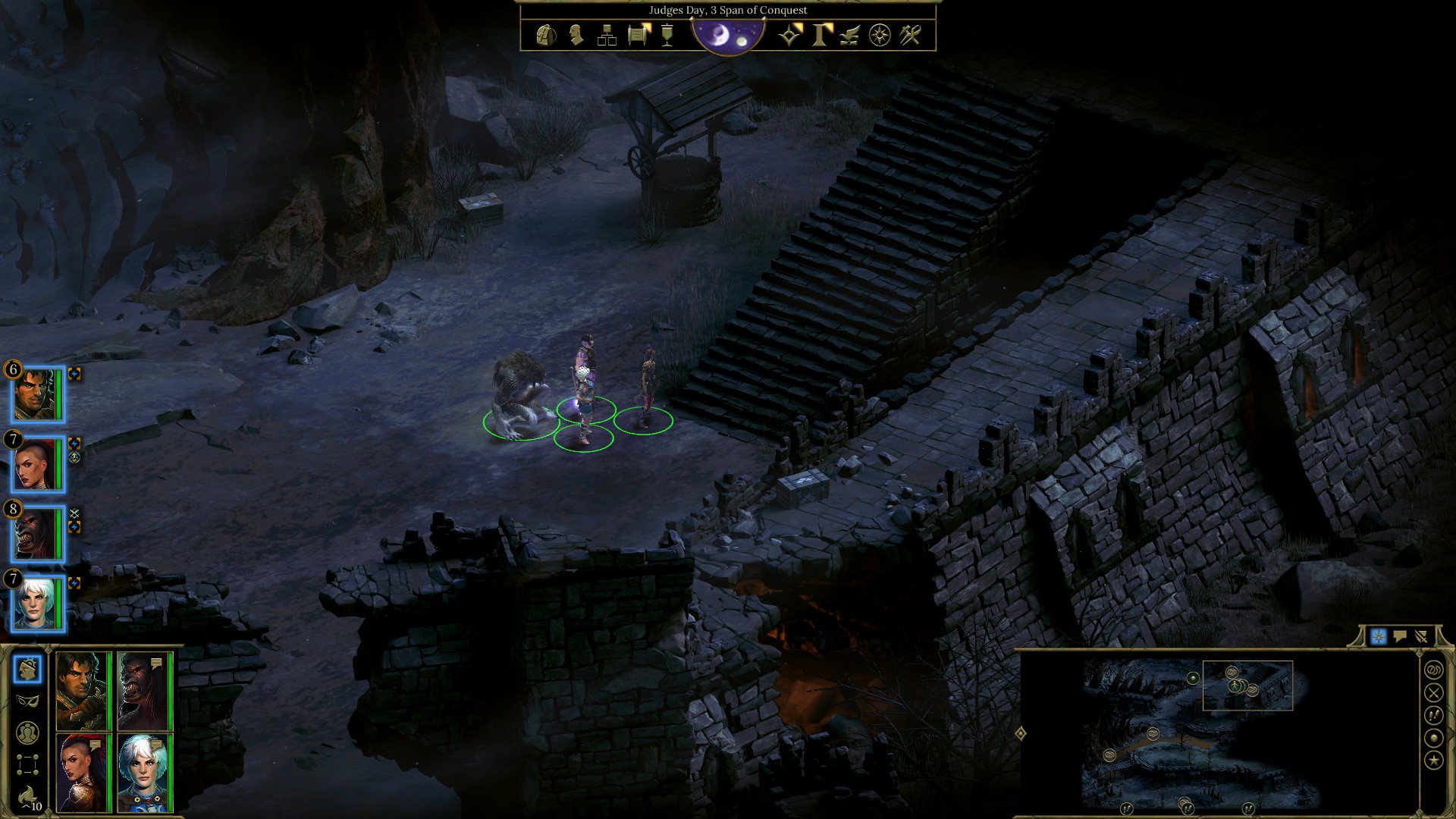
There, I found a screenshot. Thank goodness.
The companions in your party–you’ve got the pretty-standard four party members, including your own character–were fairly well-developed, though not quite as fleshed out as a Dragon Age, Pillars, etc., and if there’s one mediocre aspect of this game, it’s that the combat system–while not really the same one as most fight-and-pause-and-fight party-based RPGs uses–is nothing to write home about. Hence the reason I haven’t really got into the archetypes you can play as–while there’s actually very good variety in terms of gameplay from class to class, this was not one of the things that particularly stood out for me.
Still, between the intriguing premise of playing as a the bad guy (and good grief, if you want to be bad, you will have several chances to prove that), a world I found interesting, the choices actually affecting the plot in tangible ways, and the interactions between the major players…I’ve been more than entertained. It’s also not that long by design, which is basically to encourage you to re-play it and try different paths.
Tyranny’s probably a bit steep at $40, but, as someone who likes RPGs and enjoys when the old molds are broken in fun ways, I can’t recommend it enough on the first half-off sale that hits.
So yeah, it’s not just your computer or your internet that’s stopping you from logging in. You heard it here first. Or second, probably. Maybe even third.
You know, I was just starting to think that this year’s Winter Sale might make up for what I thought was an underwhelming Summer counterpart. Fix your stuff, Valve! I have a Holiday Bonus to spend!
UPDATE @ 4PM: IT HATH RETURNED (or it did about an hour ago)
Been playing too much things to give justice to them all fully, so I’m going to lay out my recent plays (and faves). This doesn’t mean we won’t revisit these later on, but in an effort to break the ice…without further adieu:
Far Cry 4 —“You Have Failed This Island”
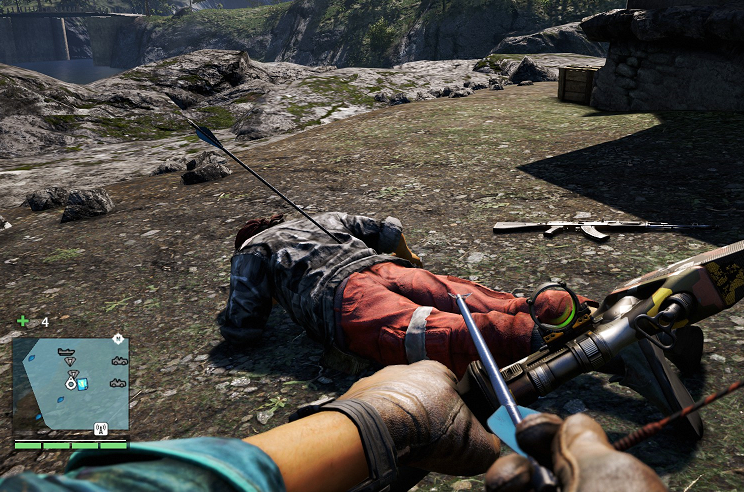
the newest addition of this Ubisoft shooter series just hit the shelves, but 4 was the one I’ve spent the most time with (by about twice over) of any FC game other than the spin-off “Blood Dragon.” To be sure, the game still houses some of the quirks that I find off-putting, and the storyline really eventually did feel like it was getting my way, but I really enjoyed doing my Green Arrow impression as I stealthily took base after base from the fascist ruler of a rather beautiful island. While I could list a bunch of complaints–skinning the bizarrely-hostile wild animals as an upgrade system rubs me the wrong way, the guy on the radio of the vehicles is just freaking annoying, and the storyline seems like on overly long, unwieldly US foreign policy analogy–the fact is that I enjoyed the vast majority of the 35 hours I spent on the game.
The driving mechanics felt right to me, successfully giving vehicles a good amount of “weight” and avoiding the GTA-feeling of driving a car on skates. The combat was fun, and FC4 implements stealth well in a game where you don’t need to use stealth; for those unfamiliar with the adventures other games have had trying to do this, it’s kind of rare. I wish I could tell you more about how shooting the baddies feels, but about 90% of my combat experience was using the bow. And it was wonderful. And you can fire exploding arrows.
As with most non-mind-blowing-but-perfectly-playable-open-worlders, I’d recommend waiting for a sale, but this is the first Far Cry game since the spinoff where there was something magnetic about it to me. Better writing/story missions would’ve made this game a lot better, but it was a lot of fun. Oops! Almost forgot: this is becoming more and more redundant these days, and it’s sort par for the course for the series, but wow does the island ever look and feel great. It’s purdy. Ubisoft Montreal gets a thumbs up for this one, on balance.
And yes, UPlay still sucks.
Rocket League — “About As Much Fun As You Can Have With Your Pants On”
I mean, except…you don’t need to wear pants to play Rocket League. N
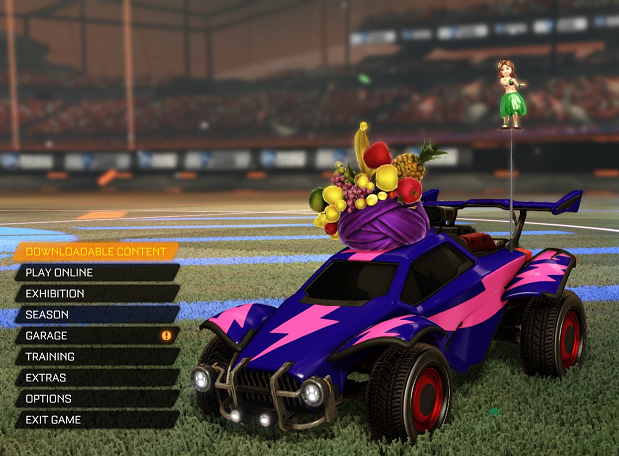
Ahem, anyway, RL is the type of game that, once you play, if it’s remotely your cup of tea, you’re very likely to wonder why it didn’t exist before now. “What if we combined boost-centric racing with indoor soccer?” Doesn’t seem like it should click as well as Rocket League does, but it turns out to be a multiplayer match made in Game Heaven.
The typical mode is 3-on-3, where you and two internet buddies (or friends you queue’d with) face off against three other players. They’re five different maps. The ball is bigger than your car. You can put lots of silly things on your car. The games last five minutes, and the goal is to–stop me if you’ve heard this!–score more goals than the other team. If the game is tied after five minutes, it goes into Sudden Death OT (first one to score wins).
The ability to flip, jump, twist, double-jump, boost, fall with style, etc.–coupled with a pretty good matchmaking system that usually pairs pretty evenly matched teams–makes this game one where both newcomers and crazy-serious-pro-gamers can enjoy (as well as those of us in-between). There are other modes as well, though it’s definitely optimized at 3-on-3, and you can try 4v4 or playing with a giant puck as well.
Rocket League is so much fun that it’s one of the few games I’ve played recently where I’d just say “buy it now.” It’s $20 at full price, so that helps too. If FC4 surprised me with how much fun I had with a FC game, RL blew me away with how such a silly “what if we…” formula makes for such a polished, fun experience. And that polish really is evident down to fun little details like the scoring system or the ball exploding your team’s color when it crosses the goal line. It’s hard to believe that the developer, Psyonix, hadn’t done anything more notable before. That said, it’s a helluva breakout game!
That is, if my teammates don’t eventually find out where I live and murder me for my awful defense.
Black Ops 3 — “I’m Bouncing Off The Walls Again”
Yes, I guess I’m reaching back a bit with this one, but I never did post my–mostly positive–review draft of the latest entry in the non-bad half of the Call of Duty franchise. If you can get over the typical CoD crap–yes, of course there was a patch that broke the game for a significant number of people, and of course one of the shotguns was hilariously brokenly good on release, and of course the anti-hacking “system” isn’t great–there’s actually plenty of fun to be had.
While the single-player narrative sort of trails off into something esoteric enough that it’s kind of one part incomprehensible and two parts “okay, but I really couldn’t care less,” most of the levels in the campaign were fun to play and I do admire the attempt at making the campaign center around high-tech and cyborgy stuff…even if it’s more of an attempt than a success. That said, the level design is generally pretty darn great, and someone at the studios finally realized it shouldn’t matter if you play as a guy or a gal! The latter would be a bigger step forward if so many of the character models weren’t varying shades of white, but at least they made it past step one (hint: if your main character being a specific type of person isn’t really central to the plot at all, this “why not be ______?” approach should be taken by more people).
Multiplayer is where it’s at with this title, though, and while there are a lot of differing opinions on this one, I grew to really like that BlOps 3 made movement abilities–utilizing a handy sort-of-jet-pack–a thing that becomes a key part of the gameplay. Rather than just target recognition and aim, having this as a more fully formed third dimension of gameplay makes BlOps 3 both a bit sillier and more fun to me than certain “realistic” versions of the game (such as the ones on the other side of the BlOps-Modern Warfare Divide). It’s still, at its heart, a personshoot. But Treyarch’s latest entry is a personshoot with the ability to wall-walk, use the occasional power-up, and slide under someone’s aim around a corner to hit them in the face with something. While it’s not the only way people should be making multiplayer shooters, it’s a fun way and actually a neat little departure from the typical formula.
~
We’ll be updating more often now, so there’ll be more of these to come (and again, they aren’t in place of full reviews). Happy driving-shooting-sneaking!
I was interested in what’s been called “Wild West Hotline Miami” in some circles pretty much as soon as I saw the concept art. Thus, after it was able to scrape through its kickstarter, I picked it up on the release sale. While HM has some issues (and I haven’t gotten around to playing the second one through yet, as of writing this), I can remember myself and a friend I was still with for a weekend giggling at the frenetic pace and unforgiving gameplay. We need more entries into the “you can be one-shot just like your enemies” sub-genre, because it produces some hilarious moments while also presenting different challenges than your typical shooters. Or even your typical top-down game.
So that’s the appeal for me coming in. I didn’t want a copy of Hotline Miami, but I was happy to see someone else trying to expand on HM’s formula. And, indeed, there are many similarities. While “12 is Better Than 6” has it’s own distinctive differences, I submit that if you enjoyed the gameplay of HM–and what I’ve seen of its sequel–you’ll like this title as well. Games like these are the rare single-player experiences where you’ll die so often–and so quickly–that it’s nearly impossible to get frustrated at having to reboot a level. It’s a funny balance that feels like it’s come so far back around from the typical ideas about how to avoid frustrating the player–while still providing a challenge–that it ends up working quite well.
Having said all that about how 12iBT6 relates to other games…if you haven’t played Hotline Miami, you’ll probably want to know that this game is a top-down shooter with a fast pace where part of the fun is that you can only sustain about as much damage as your opponents. Since that appears to be almost universally somewhere between 1 and 2 bullet or knife wounds, you can probably imagine why the game’s pace is so fast. Enemies will quickly react to a series of gunshots, so once you go loud, you’re in for a ridiculously intense gun battle.
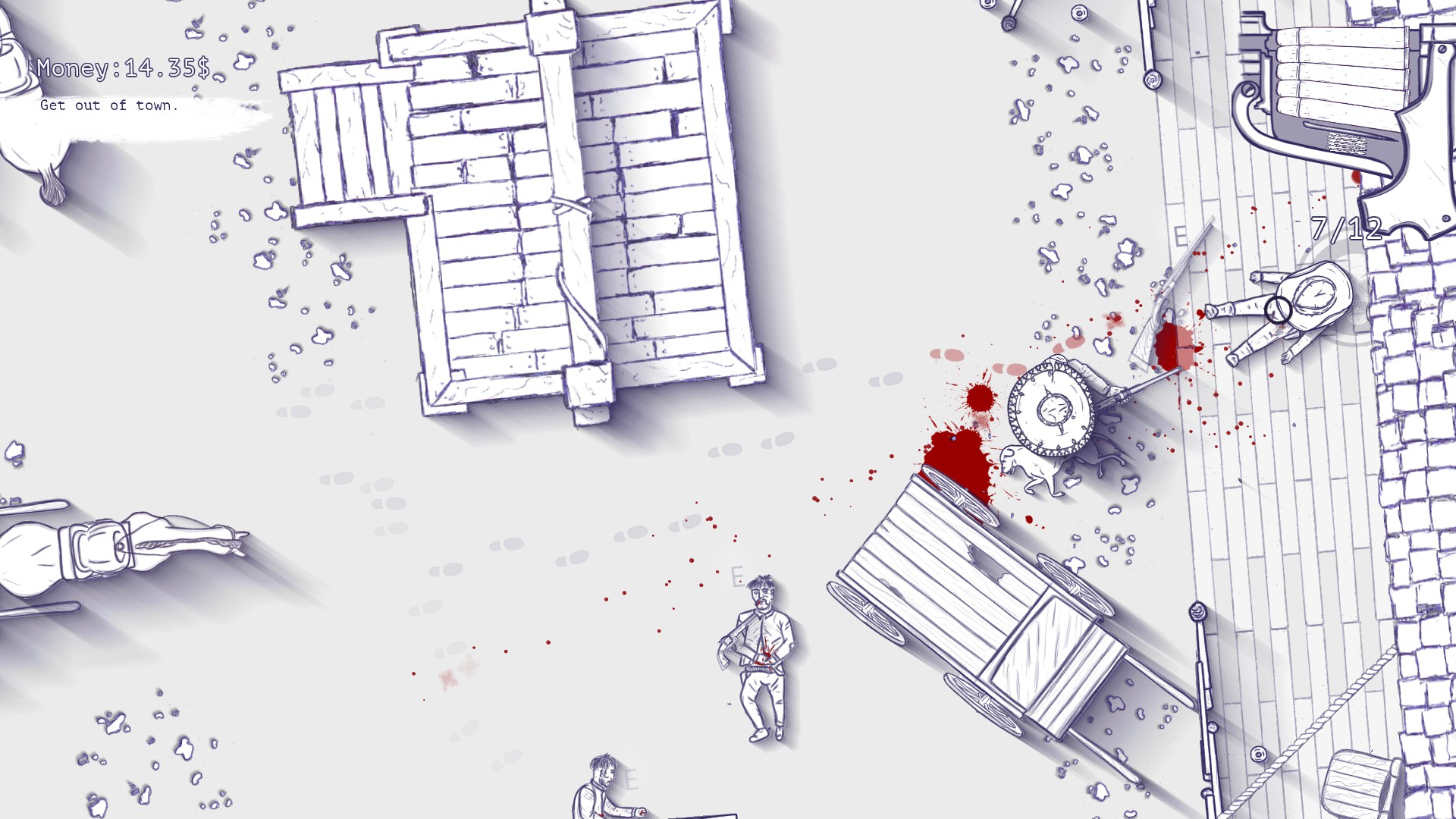
The game looks pretty darn cool, even if the only color in supply appears to be red…
Unlike Hotline Miami (and quite a lot of other games) though, there’s no real storyline beyond “your are from Mexico and desire revenge for something rather vague.” Whereas the other entries in this subgenre I mentioned gave me enough hints about a story that my killing of baddies (er, or worse-than-my-characteries) seemed to be getting me closer to an ending that had a payoff. While 12 is Better Than 6 doesn’t need to be matched up against HM directly for it to be considered good, it’s fair to note that this element is pretty non-existent here. The story is very much a rather transparent means-to-an-end thus far, and doesn’t really show any signs of changing. If it does pick up at some point, I’ll amend this statement in my follow-up post(the actual review).
Funnily enough, Westerns (the movie genre, mind you) have, in many cases, chosen to run with stripped-down storylines. This works incredibly well if you have some combination of interesting characters and a compelling plot, as if there’s no real story beyond “dude wants revenge” that actually can enhance the larger-than-life framing of the famous gunfighters that you’re focusing on. This is to say, it’s not necessarily a bad thing to eschew a complex plot, especially in the movie genre that this game borrows from, but the nature of 12iBT6 doesn’t provide us with any real characters either. It’s almost all about the shooting of the guys who are shooting at you. At the point I’m at, I’ve talked to a grand total of two characters that I haven’t killed, and one that I haven’t shot. And yes, they’re all dudes and this is supposed to be in the Wild West and look, the storyline is not a strong part of the game thus far and it’s not even actually something that adds to the game even slightly so far. The only other thing I can think of is that the player character calls a lot of people that he’s shooting at “Gringo.”
Anyway, so the gameplay. Earlier I mentioned that if you’ve already played certain games that take place somewhere in Florida, you’d like this game. I believe that to be true, but there’s a couple important distinctions to make between the combat styles of the two. Hotline Miami and 12 is Better Than 6 both eschew the traditional semi-RPGdom of overhead shooters going back to, say, Shadowgrounds, in favor of a style that has the player just as vulnerable as what they’re shooting at. That’s cool, as it’s the larger part of what gives them a distinct style.
The combat, however, manages to be significantly different despite the similar basic concept for gameplay. Hotline Miami, to me, felt like a glorious union of top-down shooter, quick-twitch shooter, and a puzzle game. That last one is the one I want to highlight, because the combination of the first two elements left me with a game that I realized part of the reason I enjoyed so much was because I was given, for example, seven obstacles to get by, a bunch of possible ways to do it, and many chances to fail in either my planning or my execution. HM is so fast-paced that you’re both relying on your planning and the quick-twitch part of your brain to get through it. There are times you can get lucky or unlucky, sure, but mainly it’s a game where if you come up with a workable path from the start of the level to the finish, and manage to not miss a bunch of shots, you’ll beat the level. That’s harder than it sounds or it wouldn’t be a fun game, of course.
12 is Better Than 6 has a higher element of luck, if the same levels of trial-and-error when it comes to exploring levels (and dying, naturally). Part of the reason for this is the “cocking” mechanism, where you can’t just unload any weapon you find into the bad guys until they’re all dead. You don’t just have to reload when you’re out of bullets, you need to re-cock the gun after every shot you fire. Also, knifing people from the front doesn’t really work, so unless you’re somehow lucky enough to get a bunch of enemies with their backs to you–it hasn’t happened to me yet–all in a row, you’re not going to be mowing your way through levels simply because, even though the enemies can take a grand total of maybe two hits, you’re not going to be very good at eliminating groups quickly unless they line up.
I’m not exaggerating for effect there, actually. One of the few ways you can wipe out a group of three really quickly is by firing one bullet that goes through them all (you can also through a stick of dynamite at them but you can’t carry many of those). Otherwise, you do tend to end up playing peek-a-boo with a bunch of enemies, and it’s up to both your aim, your quickness in re-cocking, your decisions related to cover, and whether or not the Bullet Gods have blessed you with not getting hit. That last factor really does often come down to luck, since you can be pretty damn good at peek-a-boo and still get winged by one of the four enemies you’re playing it with. This “shooting at a mob of enemies while frantically ducking out from behind a bar’s table” thing tends to crop up very often if you’re not extremely stealthy (and some levels it’s totally unavoidable), and this definitely a key difference between HM and this game.
While it’s possible to cheese your way through levels sometimes, most of the gameplay is finding a way to eliminate targets that are away from the rest of the group, and then getting into frantic gunfights with the rest where part of the “quick-twitch” is actually re-cocking your weapon fast enough. Yeah, that’s strange, right? I feel like I need to give props to the devs for even making that a game mechanic that matters in the moment, rather than it just being a thing you do in-between encounters. Regardless of whether it’s prop-worthy, it means that the frenetic situations are the ones calling for using cover effectively, and ducking out to shoot the baddies when they’re reloading or exposed. This is in contrast to HM, where you basically do everything on the fly and the path you take is just as important as actually hitting the targets in front of you, as often they work out to be one and the same.
It also means that in its own way, 12 is Better Than 6 is less forgiving of the moments where you miss. Because you’ll need to re-cock, possibly duck back in and out of cover, and fire again. In that other game that I’m not playing right now, there are different, just as unforgiving mechanics. In this one, it’s that you really only get a couple of shots at an enemy before they get to you and kill you. The path you take doesn’t matter as much as the more-emergent HM games, but your accuracy matters more. So you’re more prone to dying because of simple physical errors, or the luck of whether or not a shot registers as a hit when you’re firing at the edge of a hitbox.
In terms of the audio/visual experience, the game lives up to previous iterations in the subgenre, as the hand-drawn graphics–shown above–are impressive if a tad minimalist from my taste. Whatever you prefer, though, the artistic skill was clearly there. The music is a series of twangy guitar that adds to the frantic pace of your duck-and-cover shootouts, and feels appropriate for the “wild west” setting. Both of these things can’t really be overstated, as the music in-particular adds to the experience for me.
“12 is Better Than 6” isn’t as good as Hotline Miami, in my opinion (which is based on completing about half the game so far), but it also isn’t a ripoff of that title so much as a distinctly different entry in the “oh wow I died really quickly and it was great” subgenre of top-down shooters. There are issues with some of the gameplay’s rough edges, and I wish the storyline was a thing (and that, well, the characters were a thing), but for $8.49, I feel like it’s hard to go wrong if you’re into top-down ridiculousness. Developed by Inkstain Games and published by Pinkapp Games, it’s still at the sale price (down from $10) through Friday at noon on Steam.












 Game Mechanics