First Impressions, Games, Reviews

What is Apex Legends and Should You Try It?

It’s been around a month since Apex Legends sneaked onto the battle royal scene. Flying under the hype-cover as it’s EA producer spent it’s time promoting their ill received Anthem game, Apex was announced the same day it launched and has since exploded in popularity. The battle royale genre has been the new bandwagon genre that the industry has flocked towards trying to make a quick buck on that the unbelievable popularity of games like Player Unknown Battle Ground and later and even more successfully, Fortnite have found. I was a fan of the original Titanfall and Titanfall 2 so a game from Respawn Entertainment was attractive to me, however Anthem provides a great example of how EA can force great studios to make something way outside of their wheelhouse in the pursuit of some popular and possibly lucrative fad. So I had some hope but also some reservations when I reinstalled Origin (sobbing) to give Apex a go.  Fortunately I was pleasantly surprised.

The game retains all the characteristics that have come to define the BR genre but, it does enough differently that the game truly stands out on it’s own and is not some sort of reskin of PUBG, Fortnite, or Black Ops 4. Probably, it’s strongest selling point is that it’s free to play. But the second and more interesting selling point is that the game has launched with a level of completion and polish that has been a breath of fresh air (looking at you Anthem). While there have been some issues with crashing (that have occasionally cut short my game sessions in frustration) it has by and large been a stable game that feels complete with some room to grow. Just about all of it’s systems launched with a level of thought and polish that I have never seen a BR game launch with and as someone who experienced the early days of PUBG that’s something I can really appreciate. That being said the game is different from it’s BR competition in a variety of more tangible ways.

From the beginning of booting up the game you’ll notice the many differences that give Apex it’s own unique BR flavor. The first thing you might notice is that instead of being able play in groups of four, two, or one, Apex forces you to play in groups of three. Did you want duos with your buddy? Too bad you’re getting a rando thrown in there. Want to play solo and truly display your dominance as the most badass Caustic (one of the games playable characters) player that ever lived? Too bad you’re going to have to carry two other total N00bs as you dive into the hottest drop you can find. On the other side the limit to three in a group is also irritating for my friend group who typically now have to leave one man out when we try and play together, but there is a reason for it. The game is structured around squads of this size and is strongest when played that way.
apex legends characters

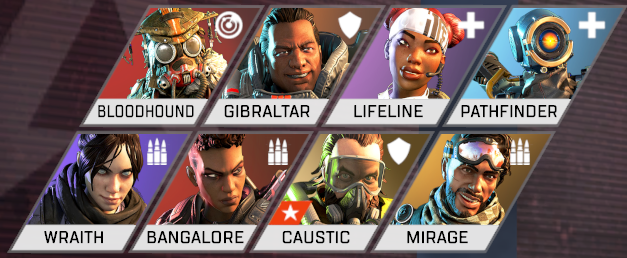
Once you’ve found your group you get to pick your “Legend”. Apex currently offers eight playable characters each with their own special abilities hitboxes, voice lines, and skins. A lot of the abilities synergize with each other, and promote different kinds of playstyles but don’t have an overwhelming effect on the game play. For example, Bangalore can drop smoke and then Bloodhound can make enemies visible in it. Your squad takes turns selecting characters and the last player to pick gets the consolation prize after probably having their main character, Wraith, “stolen” from them, of being the jumpmaster.
apex legends map v2

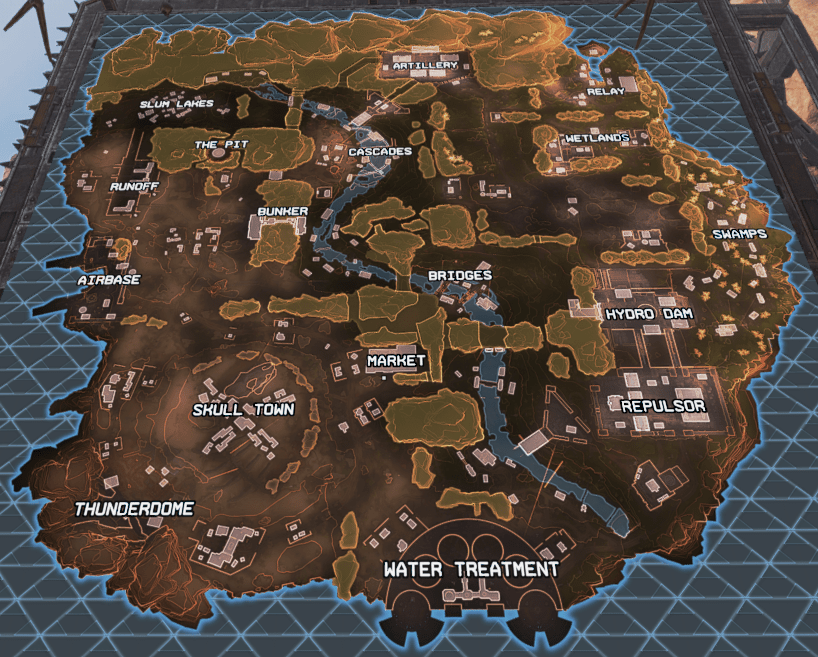
Then the game begins and you are all suddenly in the drop ship flying across a relatively small map along a random straight path. Unlike most BR games you drop with only 60 total players or 20 teams of three, this is in part because the pacing of Apex tend to be much faster than other games in it’s genre, typically lasting less than 20 minutes. The map has a variety of collections of buildings/structure where loot spawns and it’s up to your jumpmaster to decide where to drop the squad and then control your collective flights to the desired location, not that you can’t break off and drop on your own. If you are that Caustic player (the name of the character really is a reflection of some of the people who play him and this is definitely not a personally biased judgement on my part) and you want that sick highlight-reel worthy play you will most likely solo drop to that hottest of drops “the bunker” and promptly die leaving your teammates in the lurch down a man for the rest of the game and nothing in the game will stop you from doing that.

Once you land, hopefully in a group, you begin your scramble for armor and weapons to protect yourselves and begin your quest for absolute Apex domination. Communication during the mad scramble is made easy with the groundbreaking ping system. It is easy to ping weapons and attachments you find so your teammates can benefit from your frantic searching for a gun that is not the mozambique shotgun pistol. It is also easy to ping attachments you need for your guns, the location of enemies, or where you want to go (or the millions of mozambique pistols you find so they may share in your pain). And then your game can begin.

apex legends revive

Another neat wrinkle that separates Apex from the rest of the BR genre t is the revive system. In most BR games if a teammate takes enough damage they are incapacitated but able to be picked back up and continue the fight if a teammate gets to them in time or before an opponent murders them to lootable death. This mechanic is important to BR games because it heightens the sense of urgency and anxiety in the game and one of the genre’s biggest payoffs is the moments when you overcome that adversity. Those moments when the rest of your team is down and it’s just you against the enemy team and you need to pull off an “epic game moment” in order to pull through are some of the moments that I remember most in playing this game, often even more so than matches I win. Apex has complicated this mechanic in a way that adds to this. Now, even if your teammate is completely dead there is a window of just over a minute to grab their “player banner” and then you can carry it over to a respawn beacon and summon them back into the game. They’ll be as lootless as the moment they first dropped, but they’ve now got a second chance to help your squad win. This mechanic is great. It means that in a competitive fight where you only have one squadmate left standing you still can get back into the game but you are still much more vulnerable for having been completely downed. It also creates the very fun moments where your teammate who ran away from the fight like a brilliant coward can sneak back and theoretically get your entire team back into the game almost completely making up for abandoning you. The mechanic just really feels at home in a BR style game where the objective is to make it to the end not necessarily get the most kills (cough, cough, looking at you random guy who decides to peel off of the squad to hit a dropship where half the players in the entire game are landing).
apex legends zip-lines

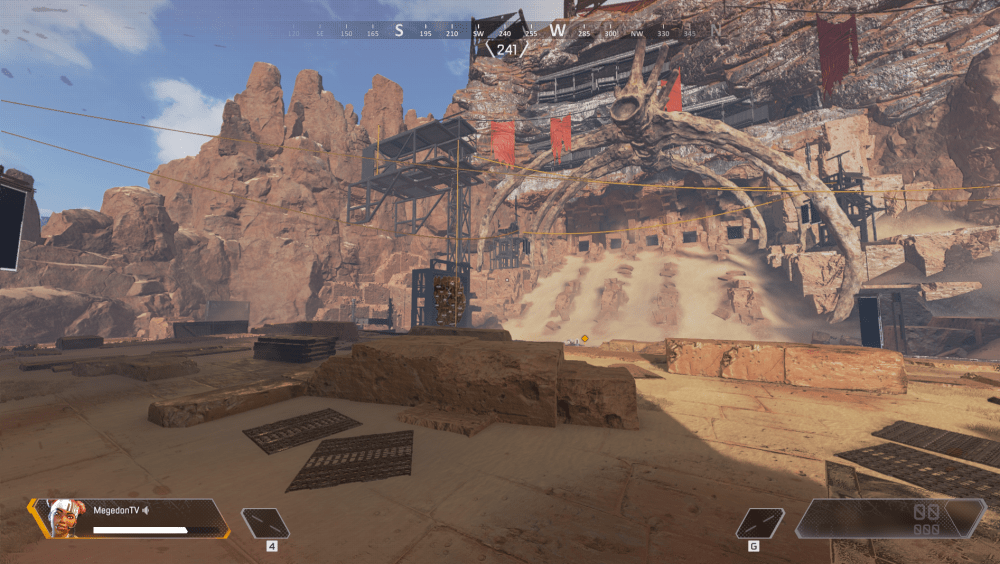
When it comes to getting around the map, Apex Legends’ characters aren’t as mobile as their kin from the Titanfall entries, but movement is more free than in any other BR game I’m aware of. There is no fall damage and the fastest way to move around the map is sliding down slopes and jumping off cliffs. Additionally you can crawl fairly high up on the various structures in the game and many of the environments enable weird parkour exploits and plays. Additionally zip lines are scattered all over the map and give players quick and easy access to different parts of the map. There are also vertical zip lines attached to balloons that allow you to basically re-drop over a short distance. Combined these features make Apex a very mobile game, and it means there’s another skillset to learn and improve on in addition to the usual shooting

It’s gunplay is probably most similar to Fortnite out of all the other BR games but doesn’t revolve around a building mechanic which for me is a huge plus. The armor and healing system in the game make sniping feel a little underpowered relative to other similar games. Finding cover and healing up to full before a team can close on you to take advantage of a sniper shot that takes you down to half health is usually doable and makes sniping a lot less lucrative. It is still very possible to snipe in the game and the supply drop only, Kraber sniper rifle  is a nightmare in the right hands, but as a whole the gameplay largely revolves around midrange to close quarters fights and you’ll rarely find yourself downed by a distant player you don’t see coming.
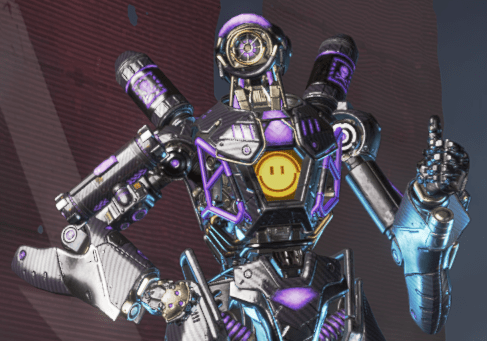
apex legends thumbs up v2

If it hasn’t been clear from my tone at this point, I’ve really been loving this game to the degree that I have developed some (probably) baseless hate for people that main certain characters or enjoy a certain style of gameplay different from my own. I have collected many of those memorable moments that keep me coming back to this game and it’s been so nice to scratch the BR itch without having to play a 40 minute game of PUBG only to get headshot by a Kar-98 from across the map or get verbally abused by an eight-year-old wunderkind with godlike building and shotgun skills in Fortnite (I swear this is a hypothetical). The game has already done enough of the things that I think are important such as the amount of polish it launched with and some prompt rebalancing of a few of the guns after the game was launched give me confidence that it will hold my interest into the future. The game is also very replayable. Relatively short matches and including short queues to get in game mean that you can play a fair number of matches without loading screens or tedious cross map running (looking at you PUBG) that tend to sap my energy and desire to play multiple matches in a single session. This will be easier with new content announced to be just over the horizon including things like new maps, characters and guns.

This all being said, the game is not without its flaws. I mentioned earlier that I’ve had some issues with the game crashing frequently enough that I’ve stopped playing much earlier than I intended to and I know those problems aren’t limited to me. There is also no way to re-enter the game after that’s happened which magnifies the issue. This has partially been addressed in some new updates to the game and even new graphics drivers that have increased the game’s stability but it’s something worth commenting on. There are also some small features that I would like eventually such as a matchmaking system so I can avoid playing against people who had 100 hours and 10k kills in like the first three days the game was out. There have also been reports of cheating that if true I hope get addressed.
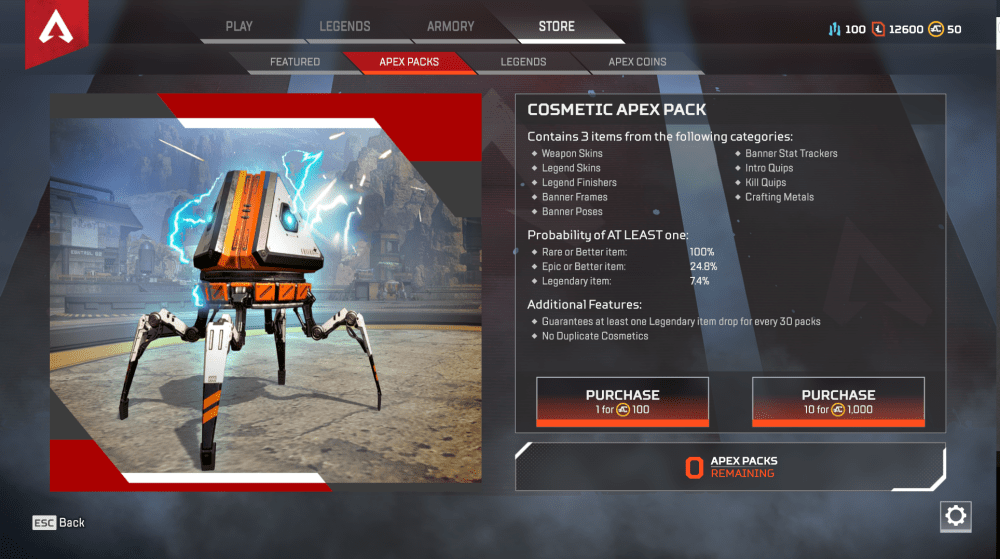
apex legends loot box

But, really all of these things are minor complaints. Really the one area that I worry about and that I think might have some badness already baking-in is unsurprisingly, the monetization system. Apex uses the typical cosmetic based loot-box system of getting money to pay for the content they’ve produced and while it isn’t the worst one I’ve seen by a huge margin I am always terribly uneasy about the potential slippery slope situation and with a producer like EA hovering over them I feel a bit more justified in my mistrust. Apex has three types of currency. Legend Tokens, which are earned by playing the game, Apex Coins, which are purchased with real money, and Crafting Metals which you obtain randomly in “Apex Packs” (which is their word for loot-box). Apex Coins can be used to purchase everything in the game, this includes skins, the two characters who aren’t initially unlocked, and Apex Packs. Legend Tokens can be used to unlock the two characters and to purchase modifications for skins you already own and that’s all I’m aware of. Crafting Metal is used for crafting specific skins you  want. You also earn an apex pack every time you level up until you hit level 20 at which point it’s every other level and then completely stops once you hit level 100. This means that you get 45 apex packs just for playing the game. But the planned obsolescence in that design is an alarming sign that combines with another odd mechanic. In the games store there is a rotating number of modified skins that you can purchase with your Legend Tokens, however you can only purchase those if you have already unlocked the skin it’s based on, which “fortunately” for you the game store informs you you can buy with Apex Coins and gives you the coin amount and a handy link to go buy the coins you need. I will stress that right now this is not a huge problem for me. I’m not even at level 50 yet, and I’ve really enjoyed the gameplay experience immensely. While I’m not planning on getting sucked-in to spending a much of money on it, I’m nonetheless concerned that this is something that will diminish my long term enjoyment as I worry that the microtransaction creep potential will blossom into a problem that could dramatically decrease the quality of what is currently a great game.

Possible future monetization-ocalypse aside, I really do recommend playing this game if any of what I described is at all interesting to you. The prerequisites to play are very minor for most people. You either need  a computer just above the performance level of a potato, a playstation 4 or xbox one past those hurtles the only cost to play the game is free.
 

First Impressions, Games

Impressions on the Mass Effect Trial

mass-effect-andromeda8
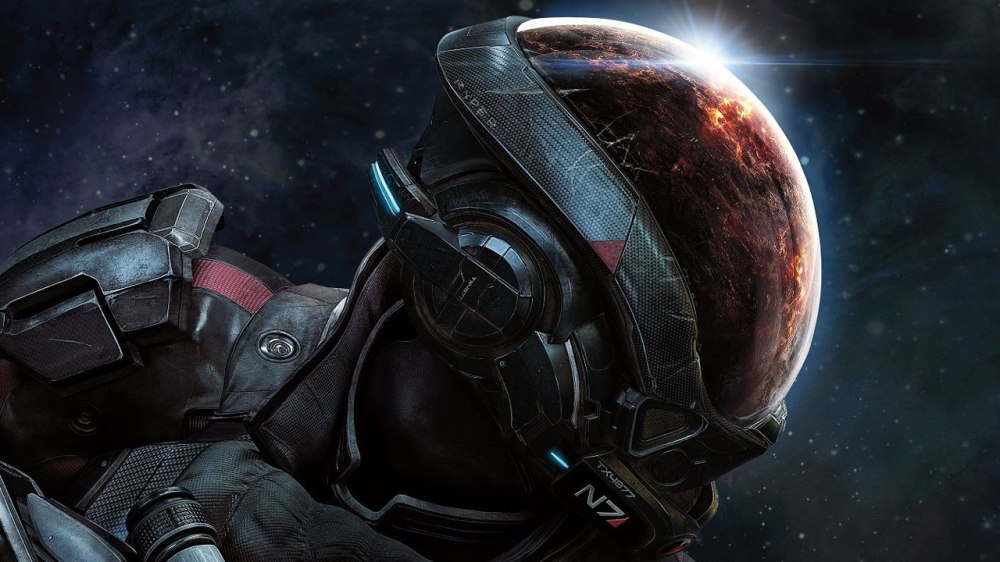
In space, no one can hear you complain inside your helmet.

So, there’s been a lot of pre-release noise in regard to Mass Effect: Andromeda. The fourth entry in the series had caught some flak from more than a few people based on silly-looking animations and a few other things that are equally hard to summarize or care about. For this series, this isn’t anything new, of course.

However, there was enough of it out there that, when EA/Bioware added the ability to play up to a certain point (and keep the progress once the game was officially released) for $5 to access the game via Origin Insider (which also gives me a 10% off coupon if I choose to buy the game, for a whopping $2 of savings in total!), I jumped on the opportunity. A

Full disclosure – I really enjoyed the original trilogy, despite its warts. I’d go as far as to say its one of the few series that exists that I feel game-love for. I also liked ME3 and ME1 better than ME2.

I’m not someone who reviews games as my livelihood and Game Mechanics is just a group of friends posting whenever the need to write on entertainment hits, so I have very little experience in writing about a game before the actual release. To help flesh things out for people who’re on the fence about pre-ordering vs. waiting for reviews vs. waiting for a sale vs. skipping this title vs. hiding inside a bunker and refusing to interact with Bioware-produced media ever again, I put it out there that I was “buying in” to the first ten hours, and gathered questions that my pals on a couple different social media platforms had about it. Those appear after my initial summary, which is below. Hope this helps!

~


Mass Effect: Andromeda launches the player back into the same universe as the first three games, only this time you’re playing as Pathfinder Pick-A-Name Ryder rather than Commander Pick-A-Name Shepard. Oh, and also, once you set up your Ryder, you learn that you’re part of the Andromeda Initiative, a private venture to cross “dark space” from the Milky Way to the Andromeda Galaxy. And also it’s 600 years later than the end of ME3, because apparently that’s how long it takes for your “Ark” ship to get from one galaxy to another. And you’ve been woken up and, inexplicably, the first thing they give you is coffee which anyone could tell you is a terrible choice for the first thing you ingest directly out of 600 years of cryostasis.

It’s worth noting that, as with the vast, vast majority of other video games, we’re limited to the gender binary in constructing our Ryder in Mass Effect: Andromeda. If you play a guy, you’ll have a gal twin sister, and vice versa. I didn’t really expect anything else, but it does seem something that developers should try harder with in the future, since having the option to build your character from the ground-up is basically an acknowledgment that playing a specific type of character isn’t really key to the way you interact with the game.

Anyway, so you’re part of the AI, and your Ark has exited dark space and collided with a bunch of space-glowy-crap that has a name that’s easily less convincing than “space-glowy-crap,” and naturally some of the tutorial is you figuring out the basic mechanics in order to help your shipmates fix a messed-up widget or two.

Did I say you were the “Pathfinder”? Just kidding, it’s your Dad. On a related note, a Pathfinder is apparently the person in charge of finding a new world to live on (a “Golden World” according to the ME:A jargon). I’m not really sure exactly what the credentials for this position involve, seeing as once your dad does the typical Disney parental thing and croaks in order to make sure you live through an encounter with lizard-people, you’re elevated to the position based on his dying proclamation. You then discover that your part of the expedition has actually been the most fortunate, probably, as none of the other Arks–Turian, Salarian, Asari (all names that’ll be familiar if you’ve played one of the first three games, and if not…they’re fellow aliens from the Milky Way)–have shown up yet, and the “Nexus” space station that was sent ahead of you to give you all a home base is behind schedule, has already had to fight off a rebellion (and exile some people, which is definitely going to come up again), is low on resources, and sustained losses to its leadership team to the point where the replacements are now sort of politically at each other’s throats over who has control over what part of the expedition. Hooray!

If this makes it sound like you’re a bunch of Space Incompetents from Planet Dipshit, the good news is that doesn’t really wreck the experience so much as actually add something! For one thing, this seems pretty much how a billionaire-funded private space enterprise would go –  just look at SpaceX. For another, being thrown into a situation where the leadership structure is in tatters and nothing seems to be going the way anyone planned is actually pretty interesting because it bucks the original Mass Effect story arc practice where Shepard was learning about systems already in place that previously hadn’t involved humans or the Systems Alliance, and replaces it with you being relied upon as one of the people to make chicken salad out of chicken shit as Pathfinder Ryder.

Once Cradwap Ryder–sadly, I was one character short of “Cradwapper” but no one should care about that–had an appropriately terrifying vision, neon hair (and let it be said that the character customization is quite fun, as always), and had been confirmed as the Mass Effect: Andromeda equivalent of a Vanguard, we were off to the races. Well, okay, technically that all happened before the Ryder’s father died in a selfless attempt to inject pre-fabricated feelings into the opening couple levels.

The classes have different names and allow for a little more variation within soldiery-types than other Mass Effect games, but otherwise they should seem pretty familiar to veterans of the series. For new people, you’re going to be picking a class that gives your character some ability in Typical Soldiery Shooty Things, Using Drones & Robots To Shoot Things, or Using Your Augmented Brain To Toss People In The Air And Cackle, or some combination of the three. I picked the one that’s a combination of the first and last, because I haven’t yet been able to come up with a good answer to the question, “what is a bad thing about being able to charge into people and headbutt them with brainpower, yet also still being able to operate the gun you are holding?”

And so Cradwap Ryder was off to a couple different places. The first couple levels gave me a chance to get a feel for combat, which is fine, and the interface, which is also, again, fine. The AI of the enemies/your two companions has come under fire as one of the things that needs work whenever Bioware gets around to patching things, and I’ll say that that’s a valid complaint (if overblown like virtually every complaint). Ryder and I had very little trouble with disposing with most enemy combatants on Normal difficulty, up until we got to the point where it’s a big enough fight in a relatively open area that you sort of need your allies to contribute.

At that point, I was sort of glaring sidelong at my idiot comrades and cursing under my breath the same way I do when I’m stuck with an Overwatch team that doesn’t appear to comprehend that at least going through the motions of Shooting What Is In Front Of You And Is Also Shooting You would be extremely helpful to allow me to get us through this fight. I had one other companion–I’d give you the names, but I feel like it’s relevant that none of them made much of an impression during my time with the game, so you’ll have to look it up–who had similar abilities to my character, which was helpful about half the way time. The other half, she went headlong into the middle of four enemies and had to be revived (the typical mechanic where you crouch near your friend’s broken, shattered body and hit “E” until they’re Just Fine After All!) or I had to fight with just me and Idiot No. 2 for the rest of the battle.

To be fair, when it was a more tunnelly battle with lots of cover, my allies did fine. But this engagement, in the second area of the final mission that the Origin Access buys you, uh, access to, you’re fighting around and inside a multi-leveled base, ostensibly an attempt at a sort of evaluation colony before it was attacked by another non-native race called the Kett. And this basically broke my teammates and thus was the only time I died other than my usual handful of deaths involving idiotically walking off a cliff.

In regard to the combat overall, I say “fine” because, while not on the same level of futility as the friendly AI, the enemy AI also makes some puzzling decisions. Such as reinforcements dropping out of a shuttle onto a roof and then bumping into each other in their attempts to be the first one to jump down to the surface and combat The Mighty Cradwap And His Two Moron Disciples. I also say “fine” rather than “great,” because, while I had no problem with the shooting mechanics or using the powers, the Kett, which make up your enemies in the first couple levels, gave the combat a distinctly Mass Effect 1’s Downside feel where it seems like the game has two simultaneous ideas going that are at war with each other: 1. it wants this to be an epic third-person cover-based battle 2. inexplicably gives you a foe type or two whose entire purpose is to try and get into melee range, which are just numerous enough that the first idea doesn’t really pan out. Thus far, the inventory system–related to the combat for obvious reasons–feels similarly Mass Effect 1, in that it’s a mess (as ME1’s kinda was).

However, the added mobility options are a plus, as you’ve also been given the options to “dodge” or use your kinda-jump-jets to quickly relocate, so while this overall feel is way less fluid than the combat in ME3 or even ME2, what you’re left with is something that feels very much like the pieces are in place–especially with the idea that you’ll get more than just your Headbutt and Shoot A Bolt Of Hurty Stuff abilities later on–for plenty of fun. And said ability to jump/boost in any direction sort of helps offset the cover system – the game assures you you’ll automatically take over when you approach a viable object with your gun out, and this works about as inconsistently as you might think if you were given such vague instructions.

Anyway, fun! I certainly did have some, I just wish I could’ve upped my character past Level 5 to see what lies beyond. I don’t think it helped that it’s sort of impossible to see the basic Kett enemies as anything other than “the guys you fight because you have to fight someone to learn to fight.”

Speaking of seeing, that was another thing that merits mentioning. I’d say the proper critique for Mass Effect: Andromeda’s graphics is that they’re not an improvement, from what I’ve seen, on Mass Effect 3, and there are indeed a few more rough edges than in the previous two games. The stuff about the facial animations and character models are both pretty overblown, unless you somehow expected Bioware to suddenly stop having a problem getting the eyes and teeth to look 100% like they go with the skin. I didn’t, so whatever – I wish they’d get a little better at this, but truly this isn’t near the middle of my complaints list.

And I suppose that’s the ultimate conclusion here. A lot of the complaints about Mass Effect: Andromeda are valid, and there’s the unshakable idea for me that this game absolutely should have more polish than it does given all the time that Bioware’s had to craft the first chapter in the new story arc of this series–it’s a little bizarre to be making my way through levels with the simultaneous feelings that the game’s mechanics give the potential for the most dynamic combat/movement in the series, while on the other hand the actual product thus far is something closer to ME1’s combat only not that good. The trial, also, really doesn’t get us deep enough into levelling  for me to look at a bunch of different abilities/tech tree stuff. To say nothing of the element of choice and decisions affecting the storyline and such, a key component of RPGing that understandably hadn’t appeared in the early going.

But overall, despite these caveats and the fact that I really haven’t gotten to know any of the characters yet for any of them to be particularly memorable, I can’t deny that I was pretty much instantly sucked back into the universe. The setting is interesting, the potential conflicts within Nexus leadership and beyond, in the Helios Cluster, are both compelling. None of the characters seem potential-less, just the course of a handful of plot missions didn’t give me much chance to get to know them. The combat really doe seem like it could be significantly. better once I reach level 10 or so. If the question is, “were you, given your own background as a ME fan, convinced you should buy it?” the answer is yes. It’s with with the caveat that I’m not as happy as I thought I’d be, but it’s a yes.

However, a lot of you had other questions, which I’ve done my best to answer below:

Q: Is it even any good? Mass Effect is my favorite series ever, just didn’t have time to play the trial. Worried it will suck.

It feels to me like it’ll be somewhere in the considerable gray territory where it’ll get a fair amount of deserved flak, while still being worth playing (especially if you’ve like the first three). I say that as someone who, also, loves the Mass Effect series despite its warts.

I will say I definitely found parts of it to be lacking, but I also had no trouble getting into the game during my trial time.

What’s that all add up to? For me, it means I’ll skip the digital deluxe stuff and just go for the standard edition.

Q: Can I/should I play this if I couldn’t quite get into ME1?

A: I’m going to say no, not right now. If you like the idea of getting into the series but had a hard time getting into the first, the best starting point is likely to try ME2 – ME2 revamped the gameplay in a way that’s a significant break from the first, so there’s a good chance that if you didn’t get into the first all that much that the second’s reboot of that part of the gameplay will resonate with you. Plus, that way you get some of the sense of build-up to ME3’s climax (assuming you like ME2 enough to keep going).

The weird thing about this game is that, in terms of its graphics style, the first couple missions’ aesthetic, and the combat, this feels like it’s got similar warts to ME1. So if that wasn’t your jam to the point where you couldn’t hold your nose and play through it, I don’t recommend starting here.

Q: re the character model animations as frequently silly as people have made them out to be? Bioware’s animation always had awkward moments, but it sounds like they are far more apparent this time around.

A: As with a lot of the pre-release buzz going around about the game’s issues, it’s both 1. an actual annoyance in some instance 2. horrendously overblown by the Leap To Conclusions section of the internet. The fact is that there’s always been some silly shit in Bioware games, and in regard to facial animations it’s really just more of the same. Disappointing that it wasn’t more fine-tuned? I guess. But the only thing that was remotely glaring in my experience was the example below.

Q: How goofy are the walk/running cycles for your character?

The one place I’ll say that I found it annoying was when the running animation try to realistically portray the way people move when you’ve been running in one direction, and then quickly switch directions – this animation feels like it was built for wide-open areas, so when it kicks it right next to a wall or a box, it’s made my Andromeda Initiative Pathfinder look like a frigging jackass who’s trying to show off the stupidest ways he can run without falling. Practically, the issue is that sometimes this leads to me getting hung up on said object (and sometimes getting shot).

Q: Also, how does the switching between 4 favorite power load outs feel? Especially mid-battle?

The interface itself is definitely not a problem in battle – it feels pretty intuitive, even as the layout reminds me more of the first game than the second or third. I didn’t get too deep into the tech trees, obviously, but it’s not on my list of complaints.

Q: Does the ass-car known as the Mako return?

A: No, but it had a child with a hummer that you’ll get to drive. I have no idea what to say about how it handles, as I suspect it’s going to be rather polarizing like its parent-vehicle.

Q: Has Bioware delved further into non-hetero/queer relationship options for the main character/supporting cast?

A: This is a great question, which I wish I’d have time to reach. Unfortunately, with trial time only taking me through the opening sequence, boarding of the Nexus, and going to a couple cruddy planets, I pretty obviously hadn’t hit the downtime in-between plot missions yet where you have an opportunity to get to know your squadmates better.

Q: Also, can the main character still inflate their ass and float around on the ceiling to avoid gun battles?

No, but it’s pretty easy to accidentally jump-jet into an area that you don’t fit in very well, and then get shot like a jackass. I accomplished this a couple times underneath the base structures in the second area (the one where my squadmates freaked the hell out). The game could’ve used a lot more polish in terms of hints about “can I go under there without my character suddenly becoming afraid of walking.”

Q: Are the shoes fancy enough?

A: Not during my gameplay, but my character is still only Level 5 – there is ample potential for fancier shoes to make an appearance.

Q: Great game or greatest game?

A: Sort of doubt it’s either one, but it’s a lot of fun to be back in this game world. Remains to be seen if it makes more of a long-term impression than that, or if the Andromeda adventures end up playing Hobbit Trilogy (fun and worth your time, but stretched thin and mainly coasting on the success of the previous trilogy) to the first three games’ Lord of the Rings (very good), but the good news is that I don’t think it sucks!


First Impressions, Games

Exploring Assassin’s Creed 3 is Worse Than Syphilitic Corn

I’ve been playing a lot of Assassin’s Creed 3 lately, and the phrase that best sums up this experience is “Why did I even bother”. The game starts off alright enough. You start off playing Haytham, who’s a man of mystery and parkour, and the controls feel tight, and the plot seems interesting right from the start. The first 2-3 hours are downright enjoyable: you get minimal Desmond, you’re in a cool ruin when you ARE Desmond, and you’re in a somewhat content-rich era of history, involving two present-day superpowers (British and France) and one future superpower (‘MURICA). The game feels like it has potential. It feels like maybe, maybe this game is a worthy successor to Assassin’s Creed: Revelations. That feeling is a lie. A filthy, filthy toilet of a lie.

Like this, but after you’ve been to Taco Bell and eaten 12  under-cooked Gorditas.  You know, a typical Tuesday.

First, let’s talk about the environment.  Having a wilderness (easily the most expansive area of the game) to run around in is a wonderful idea.  The idea of moving from tree to tree is brilliant, and makes nature free-running actually possible.  No longer is horse-riding essential for getting around!  Ah, if only these words were true.  Alas, they are not.  You see, Ubisoft inserted snow into this game.  What’s wrong with snow you might ask?  Normally, there’s nothing wrong with it.  I like snow in real life.  It’s fun to ski over, or have fun snow shenanigans with friends and family in. Like that time I got turned into a snowman.

In this game though, it’s horrible.  When you don’t have a horse, you move at a rate approximating a turtle trying to outrun a particularly threatening banana.  When you do have a horse, the environment actually works against you.  There will be hills hidden under the snow you cannot see, and this means you will either run into an invisible wall your horse cannot climb, or your valiant steed will bravely fling itself off of a 5 foot high cliff and… die, for some reason.  I wasn’t aware horses were made of stained glass back in colonial times, but there you are.  So you’re forced to stick to the roads if you want to get anywhere quick.  Which kind of negates the point of giving the player a wilderness to explore, don’tcha think?

“But Aaron” I hear you say, lip aquiver, “it’s not winter ALL the time!  Surely, it can’t be winter for more than a part of the game?”  And you’re right, it’s not winter all the time.  Just during the interesting sections of the game that take place in the wilderness.  Now, I hear some folks waving their hands and blowing raspberries.  While this is a fun group activity, bear with me for a minute.

Wha- No, no, not literally!  Back in the closet, Cinnamon!

“Why not just do your exploring in the summer, and then stay on the roads for the winter story missions?” I hear you ask, lips flapping in your self-generated breeze.  Excellent question!  Because then, what’s the point of having an expansive wilderness to explore in the first place?  You either spend all your time wandering through it completing side quests while avoiding the main plot, or you’re prohibited from doing any meaningful exploration/using alternative travel routes to the main quest by the game’s actual environment.  The previously mentioned tree travel is hard to access during wintertime, due to the also-previously-mentioned snow cover that tends to cover up landmark areas where you’d access this network, and running through snow on foot feels like you’re running a mental marathon of boredom.  It’s like the game is testing whether your fingers or your attention span runs out first.  The inclusion of unlockable fast travel points (a la fort liberation) to move from point to point quickly is nice, but then we return to the original question: What’s the point of having an expansive wilderness to explore in the first place?  Especially if you’re either going to zip on by it when possible, or it actively discourages you from exploring.

The answer is simple, and actually hearkens back to Assassin’s Creed 1 (though done much worse).  It’s artificial gameplay extension, plain and simple.  Except instead of giving you a mechanism that’ll always work to help you move around the map more quickly (a horse), the map is designed to slow you down for the reasons stated.  Hidden hills, an environment that can only be explored when the main plot has nothing to do with it, treetop travel that’s either circuitous or hidden, it all adds up to gameplay that’s pointless, drawn out, and boring.  It’s a problem in the cities too, though it’s not as clear as in the wilderness.  The streets of towns have been moved closer together, making rooftop travel more viable than in older games, and horses have had their speed drastically reduced as well, encouraging you to free-run your way through Colonial Boston and New York.  No, seriously, you run faster on foot than you do on a horse, and there are many more alleyways horses cannot venture down than in prior games.  And yet, frequently, you’ll find areas of town where the game seems to intentionally screw with you.  Randomly, streets will widen for a couple hundred feet in either direction and you’ll be stranded like Tom Hanks in Castaway. Or you’ll hop from a roof to a town tree that can be interacted with in the wild, but unbeknownst to you, some merry prankster lubed the tree up with Vaseline and before you know it, you’ve fallen out of the tree and into a squad of British soldiers.

Handle the idiot George, I’ve tea to fetch.

This brings us to the second major issue: There are only 3 areas, and they’re all boring.  You have two colonial towns, and a massive wilderness.  Sure there’s history surrounding each location, but once you’ve pushed past that, who cares?  Boston and New York are functionally the same, and the wilderness has the previously discussed issues.  So when you get down to it, what’s there really to explore?  The sailing portions of the game are also basically nonexistent, and they’re some of the most fun I’ve ever had playing a video game.  Why cut them so short? Why fully explore New York when it’s just the same re-arrangement of buildings as Boston? Why go fully explore the wilderness when it has no bearing on the plot?  Why not break the wilderness up into several areas, all accessible through fast travel instead of one sprawling area you have to traverse for hours upon hours upon hours to fully explore (if you care to?) Just skip the whole thing. You’d be better served going to the real cities/wilderness and wandering around for an equal amount of time.  It’s a more enjoyable experience.

Except for Cinnamon.

Which brings us to the third major issue: Pacing.  The game’s fine through most of its plot, but the climax (arguably the most important part of a game) is paced horribly.  Caution, spoilers ahead!  First off, Desmond’s Dad gets captured, so you have to go and save him.  Yay, hooray.  Except this is modern day, so why doesn’t Desmond get shot by one of the several dozen security people you fight? Why does the counter-agent who’s been hounding you on each other modern day mission suddenly have a violent and unexplained crazy episode right when he’s about to take Desmond out?  Why does this whole segment last only 10-15 minutes, including loading times?  These are all excellent questions that, rather than answer, the final two Animus sequences instead chose to imitate.  The penultimate Animus Sequence has two missions, most of which involve walking and not pounding your forehead against one of the many brick walls in the game.  The final sequence is a disjointed, blurry series of events that are nigh-on impossible to relate to due to the lack of anything resembling plot structure.  For some reason, Charles Lee and not Haytham (Connor’s Dad) is the final villain.  For some reason, the only times you actually get to fight Lee are during cutscenes.  It feels like Ubisoft reversed the final two sequences for some reason and then cut out 50% of the content.

When you get right down to it, playing Assassin’s Creed 3 feels like watching an episode of Seinfeld.  It’s a game about nothing, that ends with really poor pacing.  Also, maybe something funny happened.


2/5, would not play again.  For more like this, stay tuned.

First Impressions, Games, Hello!

So, I started collecting cats.

YardNeko Atsume (Cat Collector) is my life now. I downloaded it the other day from the Play Store, a recommendation from my friend, and now I, too, am trying to convert the masses into getting it. If you remember fondly the tamagotci games from the 1990s, then this game is for you! I’m still in the early stages of this game, but here’s what I’ve learned so far:

The game came out late 2014, and only recently became available in English. The graphics are simple, looks like flash animation that isn’t worried about shadows and shade nor keeping your lines completely straight, and it’s incredibly cute. The only time something is in motion is when the cats are interacting with something you’ve placed in the yard.

You set out toys, cushions, boxes, food, etc, in your yard, and let the cats come to you. So, they’re not even really your cats, per se, but rather you are enticing all the neighborhood cats to come to your yard. Different cats like different toys and food, and so the objective, of course, is to collect all the cats (cue “Can’t Hug Every Cat”).

CatbookAs cats visit your yard, they are logged into the Catbook (think scrapbook + guestbook), which shows you their name, their personality, their power level (have NOT figured out what that means in this context, yet), the number of times they visited your yard, the type of cat, the top three goodies (toys, etc) used, and you can look at the album of photos you’ve taken of them. You can rename the cats by clicking on the name. So far, I’ve been keeping their default names.

After they’ve had their fun in your yard, they leave you with regular fish or gold fish, the currency for the game used to buy more goodies. After a while, they start giving you mementos (a friend recently was given a damp matchbox), and I’ve received a bug skin of some kind and a shiny acorn (thanks, cats! — so thoughtful). Of course, you can use real money to buy gold fish and expedite the process, but otherwise patience, cat goodies, and keeping the food bowl filled will eventually yield you fish funds.

It’s not like dollars and cents where you can simply buy something and have it take away the equivalent number of regular fish for gold fish, etc, so if you need the other kind of fish, you’ll have to do a currency exchange in the Shop. 500 regular fish for 10 gold fish, and 10 gold fish for 250 regular fish. You earn both kinds of fish at a decent enough pace as well.

Yard

Leave the app running in the background by pressing the home screen, and then check on it every once in a while to see which cats are visiting your yard. Refill the food bowl when empty, because without food there may not be any cats visiting!

When you take a picture of your cat, you have the option of pushing the photo to Twitter, so that you can let everyone know how the cats are doing. The Twitter text that comes up automatically is in Japanese, and according to Google Translate, it says “Cats Collected” but you can write your own text, of course.

So, check every once in a while, refill the food bowl, put some toys and cushions, etc, out for them to use, and collect all the cats! It’s a fun, passive game, super cute, and satisfies my cat lady needs, especially where no pets are allowed at my apartment. I really enjoy checking in to see which cats have visited the yard, and the little animations that come with using the goodies. I squee a lot. A great addition to your smartphone apps. 10/10 highly recommend.

Also, hi, this is my first post on this blog. I like video games, art, yoga, and electronic music. Nice to meet you. Commissar Taco is my fiance and he is wonderful.  :3

First Impressions, Games

My First Few Hours With “12 is Better Than 6”

I was interested in what’s been called “Wild West Hotline Miami” in some circles pretty much as soon as I saw the concept art. Thus, after it was able to scrape through its kickstarter, I picked it up on the release sale. While HM has some issues (and I haven’t gotten around to playing the second one through yet, as of writing this), I can remember myself and a friend I was still with for a weekend giggling at the frenetic pace and unforgiving gameplay. We need more entries into the “you can be one-shot just like your enemies” sub-genre, because it produces some hilarious moments while also presenting different challenges than your typical shooters. Or even your typical top-down game.

So that’s the appeal for me coming in. I didn’t want a copy of Hotline Miami, but I was happy to see someone else trying to expand on HM’s formula. And, indeed, there are many similarities. While “12 is Better Than 6” has it’s own distinctive differences, I submit that if you enjoyed the gameplay of HM–and what I’ve seen of its sequel–you’ll like this title as well. Games like these are the rare single-player experiences where you’ll die so often–and so quickly–that it’s nearly impossible to get frustrated at having to reboot a level. It’s a funny balance that feels like it’s come so far back around from the typical ideas about how to avoid frustrating the player–while still providing a challenge–that it ends up working quite well.

Having said all that about how 12iBT6 relates to other games…if you haven’t played Hotline Miami, you’ll probably want to know that this game is a top-down shooter with a fast pace where part of the fun is that you can only sustain about as much damage as your opponents. Since that appears to be almost universally somewhere between 1 and 2 bullet or knife wounds, you can probably imagine why the game’s pace is so fast. Enemies will quickly react to a series of gunshots, so once you go loud, you’re in for a ridiculously intense gun battle.

2015-11-24_00001

The game looks pretty darn cool, even if the only color in supply appears to be red…

Unlike Hotline Miami (and quite a lot of other games) though, there’s no real storyline beyond “your are from Mexico and desire revenge for something rather vague.” Whereas the other entries in this subgenre I mentioned gave me enough hints about a story that my killing of baddies (er, or worse-than-my-characteries) seemed to be getting me closer to an ending that had a payoff. While 12 is Better Than 6 doesn’t need to be matched up against HM directly for it to be considered good, it’s fair to note that this element is pretty non-existent here. The story is very much a rather transparent means-to-an-end thus far, and doesn’t really show any signs of changing. If it does pick up at some point, I’ll amend this statement in my follow-up post(the actual review).

Funnily enough, Westerns (the movie genre, mind you) have, in many cases, chosen to run with stripped-down storylines. This works incredibly well if you have some combination of interesting characters and a compelling plot, as if there’s no real story beyond “dude wants revenge” that actually can enhance the larger-than-life framing of the famous gunfighters that you’re focusing on. This is to say, it’s not necessarily a bad thing to eschew a complex plot, especially in the movie genre that this game borrows from, but the nature of 12iBT6 doesn’t provide us with any real characters either. It’s almost all about the shooting of the guys who are shooting at you. At the point I’m at, I’ve talked to a grand total of two characters that I haven’t killed, and one that I haven’t shot. And yes, they’re all dudes and this is supposed to be in the Wild West and look, the storyline is not a strong part of the game thus far and it’s not even actually something that adds to the game even slightly so far. The only other thing I can think of is that the player character calls a lot of people that he’s shooting at “Gringo.”

Anyway, so the gameplay. Earlier I mentioned that if you’ve already played certain games that take place somewhere in Florida, you’d like this game. I believe that to be true, but there’s a couple important distinctions to make between the combat styles of the two. Hotline Miami and 12 is Better Than 6 both eschew the traditional semi-RPGdom of overhead shooters going back to, say, Shadowgrounds, in favor of a style that has the player just as vulnerable as what they’re shooting at. That’s cool, as it’s the larger part of what gives them a distinct style.

The combat, however, manages to be significantly different despite the similar basic concept for gameplay. Hotline Miami, to me, felt like a glorious union of top-down shooter, quick-twitch shooter, and a puzzle game. That last one is the one I want to highlight, because the combination of the first two elements left me with a game that I realized part of the reason I enjoyed so much was because I was given, for example, seven obstacles to get by, a bunch of possible ways to do it, and many chances to fail in either my planning or my execution. HM is so fast-paced that you’re both relying on your planning and the quick-twitch part of your brain to get through it. There are times you can get lucky or unlucky, sure, but mainly it’s a game where if you come up with a workable path from the start of the level to the finish, and manage to not miss a bunch of shots, you’ll beat the level. That’s harder than it sounds or it wouldn’t be a fun game, of course.

12 is Better Than 6 has a higher element of luck, if the same levels of trial-and-error when it comes to exploring levels (and dying, naturally). Part of the reason for this is the “cocking” mechanism, where you can’t just unload any weapon you find into the bad guys until they’re all dead. You don’t just have to reload when you’re out of bullets, you need to re-cock the gun after every shot you fire. Also, knifing people from the front doesn’t really work, so unless you’re somehow lucky enough to get a bunch of enemies with their backs to you–it hasn’t happened to me yet–all in a row, you’re not going to be mowing your way through levels simply because, even though the enemies can take a grand total of maybe two hits, you’re not going to be very good at eliminating groups quickly unless they line up.

I’m not exaggerating for effect there, actually. One of the few ways you can wipe out a group of three really quickly is by firing one bullet that goes through them all (you can also through a stick of dynamite at them but you can’t carry many of those). Otherwise, you do tend to end up playing peek-a-boo with a bunch of enemies, and it’s up to both your aim, your quickness in re-cocking, your decisions related to cover, and whether or not the Bullet Gods have blessed you with not getting hit. That last factor really does often come down to luck, since you can be pretty damn good at peek-a-boo and still get winged by one of the four enemies you’re playing it with. This “shooting at a mob of enemies while frantically ducking out from behind a bar’s table” thing tends to crop up very often if you’re not extremely stealthy (and some levels it’s totally unavoidable), and this definitely a key difference between HM and this game.

While it’s possible to cheese your way through levels sometimes, most of the gameplay is finding a way to eliminate targets that are away from the rest of the group, and then getting into frantic gunfights with the rest where part of the “quick-twitch” is actually re-cocking your weapon fast enough. Yeah, that’s strange, right? I feel like I need to give props to the devs for even making that a game mechanic that matters in the moment, rather than it just being a thing you do in-between encounters. Regardless of whether it’s prop-worthy, it means that the frenetic situations are the ones calling for using cover effectively, and ducking out to shoot the baddies when they’re reloading or exposed. This is in contrast to HM, where you basically do everything on the fly and the path you take is just as important as actually hitting the targets in front of you, as often they work out to be one and the same.

It also means that in its own way, 12 is Better Than 6 is less forgiving of the moments where you miss. Because you’ll need to re-cock, possibly duck back in and out of cover, and fire again. In that other game that I’m not playing right now, there are different, just as unforgiving mechanics. In this one, it’s that you really only get a couple of shots at an enemy before they get to you and kill you. The path you take doesn’t matter as much as the more-emergent HM games, but your accuracy matters more. So you’re more prone to dying because of simple physical errors, or the luck of whether or not a shot registers as a hit when you’re firing at the edge of a hitbox.

In terms of the audio/visual experience, the game lives up to previous iterations in the subgenre, as the hand-drawn graphics–shown above–are impressive if a tad minimalist from my taste. Whatever you prefer, though, the artistic skill was clearly there. The music is a series of twangy guitar that adds to the frantic pace of your duck-and-cover shootouts, and feels appropriate for the “wild west” setting. Both of these things can’t really be overstated, as the music in-particular adds to the experience for me.

“12 is Better Than 6” isn’t as good as Hotline Miami, in my opinion (which is based on completing about half the game so far), but it also isn’t a ripoff of that title so much as a distinctly different entry in the “oh wow I died really quickly and it was great” subgenre of top-down shooters. There are issues with some of the gameplay’s rough edges, and I wish the storyline was a thing (and that, well, the characters were a thing), but for $8.49, I feel like it’s hard to go wrong if you’re into top-down ridiculousness. Developed by Inkstain Games and published by Pinkapp Games, it’s still at the sale price (down from $10) through Friday at noon on Steam.