Reviews

Manchester By the Sea: A Cathartic Gem and Future (Multiple) Oscar-Winner

Manchester By The Sea (2016)

Written and Directed by Kenneth Lonergan
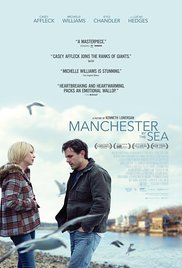
 

mv5bmtyxmjk0ndg4ml5bml5banbnxkftztgwodcynja5ote-_v1_ux182_cr00182268_al_

Let me start this review by deeply exhaling, borderline sobbing, into a nearby pillow. Jesus Christ. I can do this.

Casey Affleck jovially suggested in his recent gig hosting SNL that Manchester By The Sea was very sad. Depressingly sad. Just very, very sad. He wasn’t joking and, if anything, I could suggest that him joking about this movie being sad was a half-assed version of a trigger warning.

Overview

Manchester By The Sea follows the story of Lee Chandler (Affleck), as he attempts to navigate through life as a lowly multi-apartment custodian. He lives alone, drinks alone, eats alone. Are you seeing a trend? When he is floored by news about his brother Joe’s death (Kyle Chandler), he is forced to take on the responsibilities left to him by his brother. This includes taking permanent guardianship of his nephew, Patrick (Lucas Hedges), maintaining Joe’s fishing vessel, which in turn means dramatic changes to Lee’s life as a lonely sad person.

Throughout the narrative, we get glimpses of flashbacks that set up the more current goings-on. Each one offers the viewers a greater context behind the thought-process of Lee, his former relationship with his ex-wife Randi (Michelle Williams), and even earlier interactions with young Patrick out on Joe’s fishing boat. It is through these we come to understand why Lee is so reluctant and resistant to take on all of these responsibilities, despite wanting to respect Joe’s posthumous wishes. With everything having come to a head, Lee is forced to acknowledge the greatest factor in all of this, his past.

Catharsis (and Spoilers)

To me, this isn’t a film that truly warrants a “spoiler” warning. Much like the content of the film, it is worth tackling head-on in a way that allows just as the heading says, “catharsis.”

When I walked out of this movie, I didn’t feel like I could say anything about it. It felt real; arguably, it was too real. To say anything that vaguely resembled criticism would be almost self-deprecating. While the events that transpire within Manchester don’t fully reflect events that I have experienced, but I have dared myself to find a film that I connected, or even sympathized, with more. I failed to do so.

Manchester By The Sea has a few choked-up-worthy moments, including a seemingly inconspicuous trip to the grocery store after Lee shuffles his buddies out of his house at 2 AM. Lee trudges down to the store, too drunk to drive, and when he returns, his house is on fire. Randi is being held back by police and firefighters both as she screams, “My kids are in there!” Lee stands in awe as his life unravels before his eyes.

Following this, we see another flashback of the next day, where Lee is being questioned by police at the station about what caused the fire. It is then to be revealed that the fire may have been Lee’s fault, as a log he placed in the fireplace has begun to smolder and rolled out onto the carpet to set the home ablaze. Lee recalls not putting up the gate in front of the fireplace. Lee is let-off, scot-free, much to his own surprise. “We’re not gonna crucify you, Lee. It was an accident.” Even despite having admitted to smoking marijuana, getting drunk, and possibly dabbling in cocaine, Lee is dumbfounded to be set free. Upon confirming he has a ride home with his brother and father with police, he walks out of the interrogation room, and with that oft-noted Lee Chandler moment of hesitation, he swipes a gun off of an officer and presses the gun to his temple. He is tackled and smothered by officers and his family before he is able to commit the deed.

Fuck.

Over the course of the film, whenever Lee is faced with a difficult decision, he crumbles. That one-time-family-man Lee turns into a disheveled and drunken bar-brawler because he has no other way of coping with the shit he’s had to deal with in his life. He drinks heavily. He fights. He punches the walls. These are all textbook examples of behaviors belonging to a lot of different mental ailments, but perhaps most importantly, Manchester serves as a reminder of the crippling effects PTSD. And that is something I can connect with.

I lost my mother when I was twelve years old. Not only is it something that I have accepted in the past thirteen years, but it has become a part of who I am today. It has shaped me in many ways, including serving as a catalyst for my successes in my young adult life. In 2013, my father was dramatically affected by the explosion of an apartment building right next door to where we used to life. He has been living with the harmful effects of smoke inhalation, minor scars from the burns he received, but the most devastating thing he’s had to deal with is PTSD.

It’s hard to understand why people with PTSD do what they do. To them, it is rational thinking, but within the confines of constant neurotic turmoil. It is safe to say that my father is not the same person today as he was five years ago. It’s been an incredibly difficult experience since then, but it comes with a mutual understanding between my father and I: life is full of bumps, barriers, hazards, and breakdowns, but how we deal with these things is what makes us who we are. My father’s PTSD has slowed him down immensely, but that has not stopped him from continuing to support his family, work his steady job, and try to make the most of a terrible situation.

In many ways, watching Casey Affleck’s brilliant performance as Lee Chandler sparked a range of mixed emotions. When I saw Lee Chandler on-screen, I saw my father over and over again: a past (or present for Lee) of alcoholism, the distant relationships with family and friends,  and disengaged conversations. Manchester felt almost too real, too relatable to my life. From taking place in New England (seeing as I am from mid-coast Maine), the range of botched New England accents, catching Bruins hockey games on TV, right down to the fricking forest green Carhartt jacket that Lee wears, which I am convinced is the same one my dad still owns today.

Strengths

1. The acting in this movie is easily the best thing about it.

The combination of Casey Affleck and Michelle Williams, despite her limited supporting role, is one for the books. Affleck, calling it now, will win the Best Actor Oscar for this role. Lee Chandler is a tragic character in every sense of the word. Affleck takes on Lee’s hopes and dreams, watches them all fall apart, and tries to pick up the pieces in such a way that we aren’t capable of discerning whether or not we should help him or continue looking on at the train wreck in front of us. Furthermore, Lucas Hedges’ portrayal of Patrick, whose accent isn’t terrible, is also sure to garner the Academy’s favor. Never before have I wanted to cry watching someone pick up frozen meat off the floor before amidst a panic attack.

2. Pacing and flashback sequences are on-point.

In a world where most movie-goers aren’t really interested in sitting through a two-hour sobfest, Lonergan’s writing and direction are paced brilliantly to make sure no one is bored. Every scene feels like it means something to the story, enhancing our views of Patrick, Lee, or the past with Randi and Joe. Each flashback gives us valuable insight and information that evokes profound emotion and shows passion for the story, structure, and characters on screen. No scene is too long or too short. It just feels right. Manchester is Ken Lonergan’s baby and we need to respect him for it.

Weaknesses

1. There’s one scene that needed to be in the movie.

Near the end of the second act of Manchester, Lee is running errands downtown and runs into Randi on the street. She offers him lunch or a cup of coffee, but Lee being Lee, he wants no part of it. She is upset, not with him, but with herself. She exclaims, “I love you,” which tugs at our heartstrings even more. Randi profusely apologizes to Lee, trying to find some vulnerability, some opening, to get him to come out of his shell. She says something to the effect of “I should burn in hell for all the things I said to you,” referencing the blame-game that ensued following the deaths of their children. It might be minor, but I wanted that scene. I think it would have pushed her performance over the edge, not just teetering, for a future gold statuette for Williams.

Conclusion

Manchester By The Sea is nothing short of powerful. Despite my cathartic gushing and wallowing, I wish to repeat that it’s been a long time, if not the first time, that a movie made me feel the things I felt watching this movie. Lee might not be the easiest character to empathize with, but damn is it hard not to root for him to turn his life around.

To try to make both of us feel better, here’s Casey Affleck’s “Mayor of Dunkins” skit from SNL.

Score: A probably biased 5 Vanilla Nut Taps out of 5

Linkdumps

These Are The End Times

c4jt321

Well, in light of recent political events, they actually might be. That said, this time I was mainly referring to this:

Steam’s Winter Sale went live yesterday, and the service has succumbed to what must have been a prolonged assault of shoppers trying to get the best deals on PC games. Steam, as of this writing, is completely down. Like, all of it.

Via Polygon

So yeah, it’s not just your computer or your internet that’s stopping you from logging in. You heard it here first. Or second, probably. Maybe even third.

You know, I was just starting to think that this year’s Winter Sale might make up for what I thought was an underwhelming Summer counterpart. Fix your stuff, Valve! I have a Holiday Bonus to spend!

UPDATE @ 4PM: IT HATH RETURNED (or it did about an hour ago)


Reviews

Rogue One: A Rouge-Hot Review

My name is Will and I am not a Star Wars lifer. I’m not even a Star Wars quarter-lifer. I didn’t see my first Star Wars film until I reviewed in on my other blog, Dr. Awesome Film Reviews, back in 2013. It was a sweet experience, one that was filled with references that made me exclaim, “Yep, that was from Star Wars the whoooooole time.”

Since then, we’ve been blessed with two brand new additions to the canon, Star Wars VII: The Force Awakens, and now Rogue One. With TFA being stellar, Rogue One had big shoes to fill, since most other Star Wars prequels had been, well….terrible. So, with all of that out in the open, it’s safe to say that Rogue One was not only great, but it made people go out of their way to completely forget how to spell! What chaos!

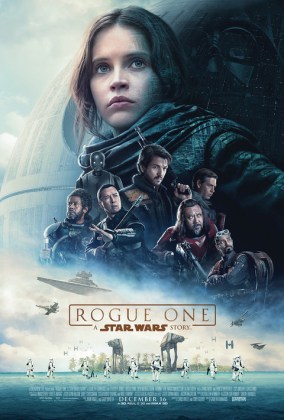
rogueone_onesheeta_1000_309ed8f6

The story of Rogue One is centered around a rogue one, Jyn Erso (Felicity Jones), who is the daughter of formerly-Imperial-scientist-turned-farmer-turned-saboteur-Imperial-scientist, Galen Erso (Mads Mikkelson). As a young girl, her father is taken from her by the Empire, more specifically by power-hungry Director Orson Krennic (Ben Mendelsohn), as Galen has the scientific book-smarts to help the Empire build a super-weapon capable of destroying planets. Wait for it…the Death Star. Flash forward approximately fifteen years and Jyn finds herself amidst Rebellion-led attempts to desperately seek intelligence about this new weapon. She falls in with an Alliance officer, Cassian Andor (Diego Luna), as they scour various planets and moons seeking information that would lead them to Jyn’s father and/or the building of the Death Star.

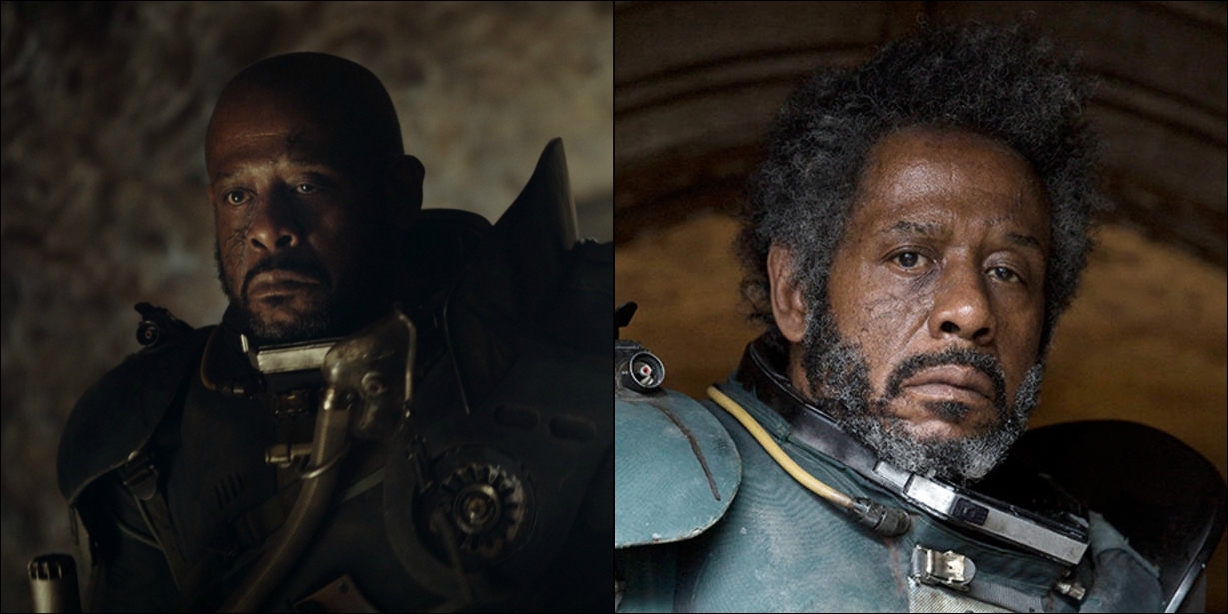
When on the moon Jedha, they are taken captive by the extreme militant, Saw Gerrara (Forest Whitaker), aka Mr. “I CAN’T ESCAPE MY FALLOUT POWER ARMOR COSPLAY,” who not only has information about the whereabouts of Galen, but also a defected Imperial pilot who aids in their quest and a hologram message from Galen himself. Within this message, we are exposed to the secret plot conducted by Galen all along: he specifically sabotaged the construction of the Death Star, the single easily-overlooked weakness that we’ve all come to know and understand from the original Star Wars film. Cassian and Jyn work together, alongside the Alliance’s rebellion, to seek out the plans for the construction of the Death Star so the Alliance can work to destroy it (in future films).

Note: beyond this mark, there be spoilers. AHHHHHHHHHHH!

Image may contain: 1 person, text

Okay, so, there’s some great stuff going on here. Like every film, the movie has incredible strengths and somewhat devastating weaknesses. To really flesh these ideas out, I’m going to directly and indirectly spoil some key sequences. You’ve been warned.

Strengths

1. The supporting cast is easily the best thing about this movie.

Without the supporting actors, this script flops. Key members of the ensemble like Whitaker, Mendelsohn, and Donnie-Facking-Yen really make this movie great. While Whitaker’s character is merely a stepping stone that gets rolled in the destruction of Jedha, Whitaker gives this character life. He’s described as an “extremist,” yet he’s awfully soft-spoken. That’s what makes him terrifying. There’s a really unsettling scene of Saw using a miniature Godzilla villain to nearly lobotomize the Imperial pilot. No thank you.

Krennic’s capture of Galen in the opening scene inevitably led him to seize more power within the Empire’s hierarchy. Mendelsohn’s performance is what dreams are made of; he’s great as a slimy, conniving, corrupt, and fear-inducing villain that’ll do anything to please Vader and the Emperor. Naturally being Australian, Mendelsohn’s rage slips in and out of accent, but y’know, I don’t care. It makes the anger more believable.

Donnie Yen, probably best known for the Ip Man franchise, plays a pivotal role in the supporting cast. He is one-part Legolas, one-part Ip Man, and one-part blind comedic relief. In the scene where Gerrara’s men capture him alongside Jyn and Cassian, he is hooded and dragged away. In doing so, he yells, “Are you kidding me? I’m blind!” Not a single person in the theater wasn’t dying of laughter.

2. Darth Vader is still too cool for Jedi school.

Holy shit. Man. Vader has two scenes in the movie, but it’s not like the Joker in Suicide Squad. MOTHERFUCKERS EVEN GOT JAMES EARL JONES IN ON THIS. Phew. Okay. I’m ready.

Vader’s presence is often alluded to early on, specifically by Krennic. Once we see him, both in burnt-skin-sitting-in-my-spa form and the classic heavy-breathing version, it evokes nothing but the classic sense of terror, suspense, and fanboy nostalgia that every 40-something felt seeing the original iteration in theaters back in the late 1970s. As for a real spoiler, Vader’s last scene, in the final five/seven minutes of the film, is nothing short of breathtaking. You watch it, you see the Alliance officers skittering like rats into a sewer grate, and you just have to say, “Those dudes are fuuuuuuuucked.”

3. The Star Wars realm continues to be vast and awesome.

Much like my first time viewing the original trilogy, this film continuously had me blown away by the creative worlds, characters, and creatures that inhabit each one. Whether its the former Jedi Temple’s home of Jedha, the Imperial base on the tropical planet, Scarif, or Eadu, the mining planet that has more lightning strikes than Florida, these places are immense and can be easily recollected because of their unique characteristics.

Weaknesses

1. Jyn Erso fits the mold as an unlikable protagonist.

The more I thought about this idea, the more it made sense. Jyn Erso is not that interesting, but rather a more plastic and less versatile Rey. The writers and new-age Star Wars-think-tankers, I’m sure, are gunning to revitalize the narrative of “female protagonists in male-dominated genres are what we need!” Yes, that is technically accurate. However, Jyn’s narrative is one that is fraught with skepticism. Do they trust her? No. Can she command the audience in an Alliance town-hall meeting? You bet your sweet bippy. But how did they establish that trust? It’s kind of loose justification, especially if you’re leaning on her biggest critic, Cassian. I guess having him feel guilty about maybe sniping Galen without her knowledge is enough. Maybe it isn’t.

Just as characters are dying left and right on screen, we feel more connected to them and their struggles than hers. “Rebellions are built on hope” she says in the trailer. Apparently Cassian’s lines aren’t the only thing she steals from this movie. Lord of the Rings fans (at least many of them) will tell you similar struggles with how whiny and childish Frodo is, and even some Star Wars fans will tell you how much they find Luke Skywalker to be equally insufferable. Jyn just doesn’t cut it. She’s got the personality of a clipboard, yet we are compelled to follow her to the end of her journey.

2. Game of Thrones character arcs are a tough pill to swallow.

Are you familiar with the story of the 300 Spartans? A rogue group of soldiers are sent on their way  like some kinda “suicide squad” to defeat an insurmountable empire? Ring any bells? It should, because Rogue One is a glorified, albeit more interesting, version of that story.

In the same vein, Game of Thrones appears. On the ride home from the movies, my fiancee was particularly upset with the fact that almost every single new character from Rogue One dies. Jyn, Cassian, Donnie Yen, Krennic, Donnie Yen’s bodyguard who probably has a name, Galen, Saw Gerrara. All of ’em. Whether it’s in battle with the Empire on Scarif, getting planet’d to death on Jedha, or totally eating your words and getting Death-Starred (I’m looking at you, Krennic), they’re just super dead. In fitting the mold of the 300 Spartans mythos, they have to die. They don’t exist in A New Hope. They are the soldiers sent, or in this case volunteered, to be slaughtered for the rebellion. My fiancee is not wrong. It doesn’t feel great to watch the characters that you establish a connection with die on-screen. The difference here is that it doesn’t feel gratuitous like Game of Thrones, where killing characters is the sport of choice for George R.R. Martin. They serve a purpose; they’re not red shirts. We care for these characters, but we also know what’s coming: a new hope.

Conclusion

Rogue One is a bonafide hit. It hits all the right notes, pulls your heart strings, and generates a lot of empathy and laughs alike. While the inevitable heat death of most of the characters isn’t awesome, the fact that easily-recognized characters emerge pre-Episode IV, including a CGI Moff Tarkin, is a nice throwback for fanboys and movie-goers everywhere. It should also be said that this is easily the most ethnically diverse cast ever assembled for a Star Wars flick. Sure we got John Boyega and Daisy Ridley for Episode VII, but this is different. This feels bigger. I can see great things coming on the horizon for this franchise.

Score: 4.5 Rouges out of 5

Reviews

Let’s Talk About Games People Shouldn’t Play (AssCreed Liberation)

Oh, hi.  It’s been a while.  Almost 3 months, I think.  *checks watch*  Yeah, about 3 months.  A whole 3 months I’ve spent trying to play Assassin’s Creed Liberation.  And in those 3 months, I’ve learned one very, very important life lesson.  This singular piece of enlightenment led me to happiness.  Want to know what it is?  Sure.  Here it is.  Don’t play Assassin’s Creed Liberation.  Hey, cool, review’s done, I’m gonna go back to playing a good game, The Last Tink-

the_scary_door_tn

*Creeeeeeeeeeeeeeeeeeeeak*

Oh.  Did.  Did anyone else hear the door open?  Has it always been like that?  I can’t remember.  Wait, it’s cold out and the cat could run away, why the fuck’s the door open?  Hold on folks, I’m gonna go shut-

CINNAMON

OH GOD CINNAMON NO

Ahem.  It has come to my attention I cannot write a review that is nothing more than a strong advisory against people playing a video game.  It has been advised that I write an actual review, or risk severe consequences.  Thus, without further ado, here goes the review of a game I actually could not complete.

You read that right, I actually could not complete this game.  I tried for several months but due to a combination of poor controls, frustrating mechanics, and a game ending glitch, my attempt to complete (much less enjoy) Liberation was doomed from the start.  Let’s start with the controls.  They’ve been ported over from Assassin’s Creed 3, so already we’re not doing so hot.  There’s the same janky free-running issues that make it nearly impossible to travel from one rooftop to another, there’s the same difficulty with trying to maneuver yourself appropriately for a kill, there’s the same frequent issues with unintentionally jumping off of a roof and disturbing the guards’ tea break… you know, the classics of any free-running-based game!  If we’re talking about classic mistakes, that is.

Whoops! An Accident!

Whoops!  An accident!

This feeds directly into the issues with the game’s mechanics; namely that the developers ignored the issues in Assassin’s Creed 3, and instead decided to made more issues with Liberation’s mechanics.  For one, the main character, Aveline de Granpré, has three personas: the socialite, the slave, and the assassin.  This is a neat concept, but there are issues with all three classes and the mechanic itself.  If you’re playing the socialite you can charm other people into letting walk behind closed doors, and you can even charm guards into following you and protecting you.  Pretty nifty, right?  Not so much; there’s very little you can do to defend yourself.  You’re extremely limited in what weapons you can carry, you cannot free-run, and your top speed measures in at about the same as a particularly lethargic tree sloth who’s just downed an entire case of sleeping pills.  So what about the slave persona?  You can free-run, but you also draw more attention in this persona, and you’re limited to the same weapons as the socialite.  The assassin persona is the best and the worst of the bunch; you have access to all the mobility and equipment you had in prior games, but you start off as notorious every time you assume this persona, and gather notoriety the quickest.  This makes the assassin persona a powerful weapon that requires judicious use.  Right off the bat, this is an issue.

The point of the AssCreed series is to adopt the persona of….. wait for it…… an assassin!  A stealthy warrior capable of blending in with the crowd!  And assuming this persona… draws attention.  Anyone else notice an issue here?  Hands up if you notice an issue.  That’s right.  The persona that should be the most low-profile of them all draws the most attention!  This makes no sense.

“But Aaron, what if the guards are on the active lookout for anyone dressed like an Assassin?”

Who said that?  Was it you, Babquez?  I’m watching you; don’t interrupt me when I’m ranting.

Back to where we left off: guards looking for you in the assassin persona.  There’s been established precedent that guards looking for assassins does bunk all to your ability to blend into the general crowd.  See: every other AssCreed game that came out prior to this game.  So why would it change in this game?  The answer is bad; it’s for the sake of the new persona swap mechanic.  I hate this mechanic.  I hate it for several reasons.  I hate that it changed everything about how you played AssCreed games (well, game.  Clearly the developers didn’t end up liking it either, since it’s yet to make a reappearance), I hate that it leads to making light of the plight of slaves in America during the 18th century, I hate that it perpetuates the idea that women’s main powers during that time were flirting with people and dressing up, and I hate that it perpetuates sexism when there was a chance to actually create a strong female character.  Let’s take a closer look, shall we?

Nope

Nope. Not like this.

First, the slave persona.  Where to start.  Well, let’s start with Aveline, who is of the mocha skinned persuasion.  She uses the slave persona to blend in with the general populace when she’s in the actual town of New Orleans, and to blend in with the escaped slave population when she’s roughin’ it in the bayou.  There’s two issues with this.  One, it downplays the hardships slaves faced in America in the 18th century by portraying someone disguised as one being free to run around the deep South without being harassed.  Two requires a bit more background info.  When you make it to the swamp and begin encountering the freed slaves/free Africans, if they’re black, they’re all dressed in tribalistic gear and face paint.  Every one.  White people in the bayou tend to be dressed in sensible clothing, and this idea for sensible dress extends to Aveline’s personas.  So the second (and third, there are three now) issue(s) with the slave persona include whitewashing Aveline by, despite her skin tone, dressing her like white “civilized” people, and dressing up the black “savage” people in tribal garb.  Maybe Ubisoft has a good reason for putting the above issues in their game, but I don’t know what they are, because I couldn’t actually play their f*%&ing game.  More on that in a bit!

For now, let’s talk about the socialite persona.  Wow.  Where to begin.  First, all of the clothing options available for the socialite accentuate Aveline’s cleavage and hide her other physical features.  All the better to charm men with.  Because a woman who’s able to use her cleavage to ensnare the attentions of men and do little else is an empowered character, right?  Right?  *crickets*  No, really, that’s the extent of what the socialite can do.  That’s why this persona is in the game.  To “charm” people.  If there’s more to the persona, I wouldn’t know, because I couldn’t play the f*%&ing game.  Almost there!

The final issue with the personas system is you can’t switch between the personas unless you have a dressing room.  Code-wise, I can understand the need for this kind of kit switching location.  It means the game can process the change of persona, and change the rules it applies to the game world based on Aveline’s appearance.  This rationale makes sense from this perspective.  In practice it takes a character who’s supposed to be mobile, mutable, and adaptable, and ties them down to a specific type of location if the player wants to utilize one of the main abilities in the game.  This is not good game design.  Individually any of these things are bad, but not game-ruining.  Combined with Aveline being the first female protagonist in the AssCreed universe, it pushes the game into the “this is both bad and problematic” realm.  Kinda like a tractor that, instead of pulling heavy equipment, sprays nacho cheese all over the place.

Cheese Fields

Soon, the pepperjack fields shall be sown

Finally, we come to the biggest issue with the game, namely that it has a serious game-ending glitch.  This is a well-known glitch, and Ubisoft has acknowledged its existence and continual presence in their game.  Sometimes, Aveline will stutter when she’s swimming.  Then you get to land.  And you keep swimming.  People can interact with you, but you can’t interact with them.  Normally, you can fix this glitch by exiting the game and re-opening it.  But sometimes?  Sometimes the game just says no.  Sometimes the game decides it doesn’t want to be played.  Sometimes, you just wind up swimming through the streets of New Orleans, unable to interact with anyone or anything, unable to remove yourself from your land-filled half-life.  I spent literal months trying to figure out how to fix this glitch, and I couldn’t.  And when I couldn’t, I realized that I could not continue.  It was only act 3 of the game, but I couldn’t find a way to replay my way up to that point.  The game mechanics.  The inability to actually play the game.  The importing of a terrible free-running system and making it worse.  I couldn’t do it.  The game beat me.


0/5 Would not play again. Burn it with fire, and don't look back.
Reviews

Quick Fixes (Games I’ve Played Lately, Part One)

Been playing too much things to give justice to them all fully, so I’m going to lay out my recent plays (and faves). This doesn’t mean we won’t revisit these later on, but in an effort to break the ice…without further adieu:

Far Cry 4 — “You Have Failed This Island” 

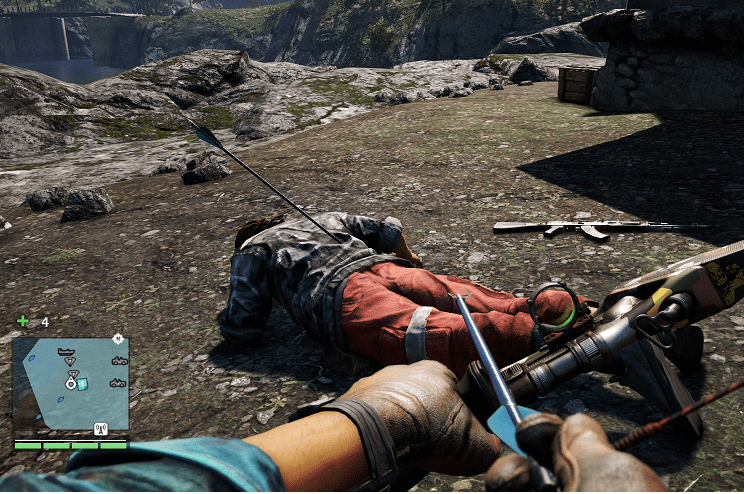
article one

the newest addition of this Ubisoft shooter series just hit the shelves, but 4 was the one I’ve spent the most time with (by about twice over) of any FC game other than the spin-off “Blood Dragon.” To be sure, the game still houses some of the quirks that I find off-putting, and the storyline really eventually did feel like it was getting my way, but I really enjoyed doing my Green Arrow impression as I stealthily took base after base from the fascist ruler of a rather beautiful island. While I could list a bunch of complaints–skinning the bizarrely-hostile wild animals as an upgrade system rubs me the wrong way, the guy on the radio of the vehicles is just freaking annoying, and the storyline seems like on overly long, unwieldly US foreign policy analogy–the fact is that I enjoyed the vast majority of the 35 hours I spent on the game.

The driving mechanics felt right to me, successfully giving vehicles a good amount of “weight” and avoiding the GTA-feeling of driving a car on skates. The combat was fun, and FC4 implements stealth well in a game where you don’t need to use stealth; for those unfamiliar with the adventures other games have had trying to do this, it’s kind of rare. I wish I could tell you more about how shooting the baddies feels, but about 90% of my combat experience was using the bow. And it was wonderful. And you can fire exploding arrows.

As with most non-mind-blowing-but-perfectly-playable-open-worlders, I’d recommend waiting for a sale, but this is the first Far Cry game since the spinoff where there was something magnetic about it to me. Better writing/story missions would’ve made this game a lot better, but it was a lot of fun. Oops! Almost forgot: this is becoming more and more redundant these days, and it’s sort par for the course for the series, but wow does the island ever look and feel great. It’s purdy. Ubisoft Montreal gets a thumbs up for this one, on balance.

And yes, UPlay still sucks.

Rocket League — “About As Much Fun As You Can Have With Your Pants On”

articletwo

I mean, except…you don’t need to wear pants to play Rocket League. N

Ahem, anyway, RL is the type of game that, once you play, if it’s remotely your cup of tea, you’re very likely to wonder why it didn’t exist before now. “What if we combined boost-centric racing with indoor soccer?” Doesn’t seem like it should click as well as Rocket League does, but it turns out to be a multiplayer match made in Game Heaven.

The typical mode is 3-on-3, where you and two internet buddies (or friends you queue’d with) face off against three other players. They’re five different maps. The ball is bigger than your car. You can put lots of silly things on your car. The games last five minutes, and the goal is to–stop me if you’ve heard this!–score more goals than the other team. If the game is tied after five minutes, it goes into Sudden Death OT (first one to score wins).

The ability to flip, jump, twist, double-jump, boost, fall with style, etc.–coupled with a pretty good matchmaking system that usually pairs pretty evenly matched teams–makes this game one where both newcomers and crazy-serious-pro-gamers can enjoy (as well as those of us in-between). There are other modes as well, though it’s definitely optimized at 3-on-3, and you can try 4v4 or playing with a giant puck as well.

Rocket League is so much fun that it’s one of the few games I’ve played recently where I’d just say “buy it now.” It’s $20 at full price, so that helps too. If FC4 surprised me with how much fun I had with a FC game, RL blew me away with how such a silly “what if we…” formula makes for such a polished, fun experience. And that polish really is evident down to fun little details like the scoring system or the ball exploding your team’s color when it crosses the goal line. It’s hard to believe that the developer, Psyonix, hadn’t done anything more notable before. That said, it’s a helluva breakout game!

That is, if my teammates don’t eventually find out where I live and murder me for my awful defense.


Black Ops 3 — “I’m Bouncing Off The Walls Again”

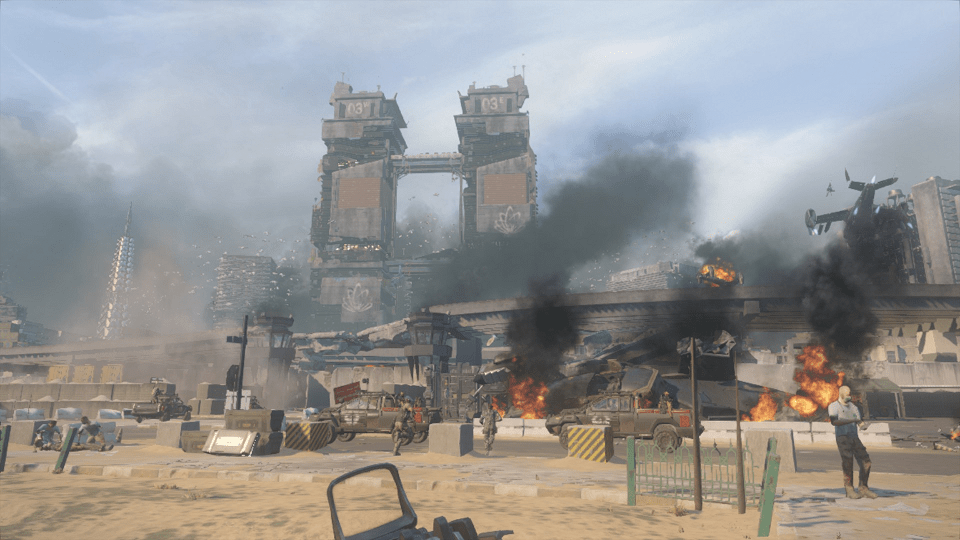
article 3.png

Yes, I guess I’m reaching back a bit with this one, but I never did post my–mostly positive–review draft of the latest entry in the non-bad half of the Call of Duty franchise. If you can get over the typical CoD crap–yes, of course there was a patch that broke the game for a significant number of people, and of course one of the shotguns was hilariously brokenly good on release, and of course the anti-hacking “system” isn’t great–there’s actually plenty of fun to be had.

While the single-player narrative sort of trails off into something esoteric enough that it’s kind of one part incomprehensible and two parts “okay, but I really couldn’t care less,” most of the levels in the campaign were fun to play and I do admire the attempt at making the campaign center around high-tech and cyborgy stuff…even if it’s more of an attempt than a success. That said, the level design is generally pretty darn great, and someone at the studios finally realized it shouldn’t matter if you play as a guy or a gal! The latter would be a bigger step forward if so many of the character models weren’t varying shades of white, but at least they made it past step one (hint: if your main character being a specific type of person isn’t really central to the plot at all, this “why not be ______?” approach should be taken by more people).

Multiplayer is where it’s at with this title, though, and while there are a lot of differing opinions on this one, I grew to really like that BlOps 3 made movement abilities–utilizing a handy sort-of-jet-pack–a thing that becomes a key part of the gameplay. Rather than just target recognition and aim, having this as a more fully formed third dimension of gameplay makes BlOps 3 both a bit sillier and more fun to me than certain “realistic” versions of the game (such as the ones on the other side of the BlOps-Modern Warfare Divide). It’s still, at its heart, a personshoot. But Treyarch’s latest entry is a personshoot with the ability to wall-walk, use the occasional power-up, and slide under someone’s aim around a corner to hit them in the face with something. While it’s not the only way people should be making multiplayer shooters, it’s a fun way and actually a neat little departure from the typical formula.

~

We’ll be updating more often now, so there’ll be more of these to come (and again, they aren’t in place of full reviews). Happy driving-shooting-sneaking!


First Impressions, Games

Exploring Assassin’s Creed 3 is Worse Than Syphilitic Corn

I’ve been playing a lot of Assassin’s Creed 3 lately, and the phrase that best sums up this experience is “Why did I even bother”. The game starts off alright enough. You start off playing Haytham, who’s a man of mystery and parkour, and the controls feel tight, and the plot seems interesting right from the start. The first 2-3 hours are downright enjoyable: you get minimal Desmond, you’re in a cool ruin when you ARE Desmond, and you’re in a somewhat content-rich era of history, involving two present-day superpowers (British and France) and one future superpower (‘MURICA). The game feels like it has potential. It feels like maybe, maybe this game is a worthy successor to Assassin’s Creed: Revelations. That feeling is a lie. A filthy, filthy toilet of a lie.

Like this, but after you’ve been to Taco Bell and eaten 12  under-cooked Gorditas.  You know, a typical Tuesday.

First, let’s talk about the environment.  Having a wilderness (easily the most expansive area of the game) to run around in is a wonderful idea.  The idea of moving from tree to tree is brilliant, and makes nature free-running actually possible.  No longer is horse-riding essential for getting around!  Ah, if only these words were true.  Alas, they are not.  You see, Ubisoft inserted snow into this game.  What’s wrong with snow you might ask?  Normally, there’s nothing wrong with it.  I like snow in real life.  It’s fun to ski over, or have fun snow shenanigans with friends and family in. Like that time I got turned into a snowman.

In this game though, it’s horrible.  When you don’t have a horse, you move at a rate approximating a turtle trying to outrun a particularly threatening banana.  When you do have a horse, the environment actually works against you.  There will be hills hidden under the snow you cannot see, and this means you will either run into an invisible wall your horse cannot climb, or your valiant steed will bravely fling itself off of a 5 foot high cliff and… die, for some reason.  I wasn’t aware horses were made of stained glass back in colonial times, but there you are.  So you’re forced to stick to the roads if you want to get anywhere quick.  Which kind of negates the point of giving the player a wilderness to explore, don’tcha think?

“But Aaron” I hear you say, lip aquiver, “it’s not winter ALL the time!  Surely, it can’t be winter for more than a part of the game?”  And you’re right, it’s not winter all the time.  Just during the interesting sections of the game that take place in the wilderness.  Now, I hear some folks waving their hands and blowing raspberries.  While this is a fun group activity, bear with me for a minute.

Wha- No, no, not literally!  Back in the closet, Cinnamon!

“Why not just do your exploring in the summer, and then stay on the roads for the winter story missions?” I hear you ask, lips flapping in your self-generated breeze.  Excellent question!  Because then, what’s the point of having an expansive wilderness to explore in the first place?  You either spend all your time wandering through it completing side quests while avoiding the main plot, or you’re prohibited from doing any meaningful exploration/using alternative travel routes to the main quest by the game’s actual environment.  The previously mentioned tree travel is hard to access during wintertime, due to the also-previously-mentioned snow cover that tends to cover up landmark areas where you’d access this network, and running through snow on foot feels like you’re running a mental marathon of boredom.  It’s like the game is testing whether your fingers or your attention span runs out first.  The inclusion of unlockable fast travel points (a la fort liberation) to move from point to point quickly is nice, but then we return to the original question: What’s the point of having an expansive wilderness to explore in the first place?  Especially if you’re either going to zip on by it when possible, or it actively discourages you from exploring.

The answer is simple, and actually hearkens back to Assassin’s Creed 1 (though done much worse).  It’s artificial gameplay extension, plain and simple.  Except instead of giving you a mechanism that’ll always work to help you move around the map more quickly (a horse), the map is designed to slow you down for the reasons stated.  Hidden hills, an environment that can only be explored when the main plot has nothing to do with it, treetop travel that’s either circuitous or hidden, it all adds up to gameplay that’s pointless, drawn out, and boring.  It’s a problem in the cities too, though it’s not as clear as in the wilderness.  The streets of towns have been moved closer together, making rooftop travel more viable than in older games, and horses have had their speed drastically reduced as well, encouraging you to free-run your way through Colonial Boston and New York.  No, seriously, you run faster on foot than you do on a horse, and there are many more alleyways horses cannot venture down than in prior games.  And yet, frequently, you’ll find areas of town where the game seems to intentionally screw with you.  Randomly, streets will widen for a couple hundred feet in either direction and you’ll be stranded like Tom Hanks in Castaway. Or you’ll hop from a roof to a town tree that can be interacted with in the wild, but unbeknownst to you, some merry prankster lubed the tree up with Vaseline and before you know it, you’ve fallen out of the tree and into a squad of British soldiers.

Handle the idiot George, I’ve tea to fetch.

This brings us to the second major issue: There are only 3 areas, and they’re all boring.  You have two colonial towns, and a massive wilderness.  Sure there’s history surrounding each location, but once you’ve pushed past that, who cares?  Boston and New York are functionally the same, and the wilderness has the previously discussed issues.  So when you get down to it, what’s there really to explore?  The sailing portions of the game are also basically nonexistent, and they’re some of the most fun I’ve ever had playing a video game.  Why cut them so short? Why fully explore New York when it’s just the same re-arrangement of buildings as Boston? Why go fully explore the wilderness when it has no bearing on the plot?  Why not break the wilderness up into several areas, all accessible through fast travel instead of one sprawling area you have to traverse for hours upon hours upon hours to fully explore (if you care to?) Just skip the whole thing. You’d be better served going to the real cities/wilderness and wandering around for an equal amount of time.  It’s a more enjoyable experience.

Except for Cinnamon.

Which brings us to the third major issue: Pacing.  The game’s fine through most of its plot, but the climax (arguably the most important part of a game) is paced horribly.  Caution, spoilers ahead!  First off, Desmond’s Dad gets captured, so you have to go and save him.  Yay, hooray.  Except this is modern day, so why doesn’t Desmond get shot by one of the several dozen security people you fight? Why does the counter-agent who’s been hounding you on each other modern day mission suddenly have a violent and unexplained crazy episode right when he’s about to take Desmond out?  Why does this whole segment last only 10-15 minutes, including loading times?  These are all excellent questions that, rather than answer, the final two Animus sequences instead chose to imitate.  The penultimate Animus Sequence has two missions, most of which involve walking and not pounding your forehead against one of the many brick walls in the game.  The final sequence is a disjointed, blurry series of events that are nigh-on impossible to relate to due to the lack of anything resembling plot structure.  For some reason, Charles Lee and not Haytham (Connor’s Dad) is the final villain.  For some reason, the only times you actually get to fight Lee are during cutscenes.  It feels like Ubisoft reversed the final two sequences for some reason and then cut out 50% of the content.

When you get right down to it, playing Assassin’s Creed 3 feels like watching an episode of Seinfeld.  It’s a game about nothing, that ends with really poor pacing.  Also, maybe something funny happened.


2/5, would not play again.  For more like this, stay tuned.

First Impressions, Games, Hello!

So, I started collecting cats.

YardNeko Atsume (Cat Collector) is my life now. I downloaded it the other day from the Play Store, a recommendation from my friend, and now I, too, am trying to convert the masses into getting it. If you remember fondly the tamagotci games from the 1990s, then this game is for you! I’m still in the early stages of this game, but here’s what I’ve learned so far:

The game came out late 2014, and only recently became available in English. The graphics are simple, looks like flash animation that isn’t worried about shadows and shade nor keeping your lines completely straight, and it’s incredibly cute. The only time something is in motion is when the cats are interacting with something you’ve placed in the yard.

You set out toys, cushions, boxes, food, etc, in your yard, and let the cats come to you. So, they’re not even really your cats, per se, but rather you are enticing all the neighborhood cats to come to your yard. Different cats like different toys and food, and so the objective, of course, is to collect all the cats (cue “Can’t Hug Every Cat”).

CatbookAs cats visit your yard, they are logged into the Catbook (think scrapbook + guestbook), which shows you their name, their personality, their power level (have NOT figured out what that means in this context, yet), the number of times they visited your yard, the type of cat, the top three goodies (toys, etc) used, and you can look at the album of photos you’ve taken of them. You can rename the cats by clicking on the name. So far, I’ve been keeping their default names.


After they’ve had their fun in your yard, they leave you with regular fish or gold fish, the currency for the game used to buy more goodies. After a while, they start giving you mementos (a friend recently was given a damp matchbox), and I’ve received a bug skin of some kind and a shiny acorn (thanks, cats! — so thoughtful). Of course, you can use real money to buy gold fish and expedite the process, but otherwise patience, cat goodies, and keeping the food bowl filled will eventually yield you fish funds.

It’s not like dollars and cents where you can simply buy something and have it take away the equivalent number of regular fish for gold fish, etc, so if you need the other kind of fish, you’ll have to do a currency exchange in the Shop. 500 regular fish for 10 gold fish, and 10 gold fish for 250 regular fish. You earn both kinds of fish at a decent enough pace as well.

Yard

Leave the app running in the background by pressing the home screen, and then check on it every once in a while to see which cats are visiting your yard. Refill the food bowl when empty, because without food there may not be any cats visiting!

When you take a picture of your cat, you have the option of pushing the photo to Twitter, so that you can let everyone know how the cats are doing. The Twitter text that comes up automatically is in Japanese, and according to Google Translate, it says “Cats Collected” but you can write your own text, of course.

So, check every once in a while, refill the food bowl, put some toys and cushions, etc, out for them to use, and collect all the cats! It’s a fun, passive game, super cute, and satisfies my cat lady needs, especially where no pets are allowed at my apartment. I really enjoy checking in to see which cats have visited the yard, and the little animations that come with using the goodies. I squee a lot. A great addition to your smartphone apps. 10/10 highly recommend.

Also, hi, this is my first post on this blog. I like video games, art, yoga, and electronic music. Nice to meet you. Commissar Taco is my fiance and he is wonderful.  :3

First Impressions, Games

My First Few Hours With “12 is Better Than 6”

I was interested in what’s been called “Wild West Hotline Miami” in some circles pretty much as soon as I saw the concept art. Thus, after it was able to scrape through its kickstarter, I picked it up on the release sale. While HM has some issues (and I haven’t gotten around to playing the second one through yet, as of writing this), I can remember myself and a friend I was still with for a weekend giggling at the frenetic pace and unforgiving gameplay. We need more entries into the “you can be one-shot just like your enemies” sub-genre, because it produces some hilarious moments while also presenting different challenges than your typical shooters. Or even your typical top-down game.

So that’s the appeal for me coming in. I didn’t want a copy of Hotline Miami, but I was happy to see someone else trying to expand on HM’s formula. And, indeed, there are many similarities. While “12 is Better Than 6” has it’s own distinctive differences, I submit that if you enjoyed the gameplay of HM–and what I’ve seen of its sequel–you’ll like this title as well. Games like these are the rare single-player experiences where you’ll die so often–and so quickly–that it’s nearly impossible to get frustrated at having to reboot a level. It’s a funny balance that feels like it’s come so far back around from the typical ideas about how to avoid frustrating the player–while still providing a challenge–that it ends up working quite well.

Having said all that about how 12iBT6 relates to other games…if you haven’t played Hotline Miami, you’ll probably want to know that this game is a top-down shooter with a fast pace where part of the fun is that you can only sustain about as much damage as your opponents. Since that appears to be almost universally somewhere between 1 and 2 bullet or knife wounds, you can probably imagine why the game’s pace is so fast. Enemies will quickly react to a series of gunshots, so once you go loud, you’re in for a ridiculously intense gun battle.

2015-11-24_00001

The game looks pretty darn cool, even if the only color in supply appears to be red…

Unlike Hotline Miami (and quite a lot of other games) though, there’s no real storyline beyond “your are from Mexico and desire revenge for something rather vague.” Whereas the other entries in this subgenre I mentioned gave me enough hints about a story that my killing of baddies (er, or worse-than-my-characteries) seemed to be getting me closer to an ending that had a payoff. While 12 is Better Than 6 doesn’t need to be matched up against HM directly for it to be considered good, it’s fair to note that this element is pretty non-existent here. The story is very much a rather transparent means-to-an-end thus far, and doesn’t really show any signs of changing. If it does pick up at some point, I’ll amend this statement in my follow-up post(the actual review).

Funnily enough, Westerns (the movie genre, mind you) have, in many cases, chosen to run with stripped-down storylines. This works incredibly well if you have some combination of interesting characters and a compelling plot, as if there’s no real story beyond “dude wants revenge” that actually can enhance the larger-than-life framing of the famous gunfighters that you’re focusing on. This is to say, it’s not necessarily a bad thing to eschew a complex plot, especially in the movie genre that this game borrows from, but the nature of 12iBT6 doesn’t provide us with any real characters either. It’s almost all about the shooting of the guys who are shooting at you. At the point I’m at, I’ve talked to a grand total of two characters that I haven’t killed, and one that I haven’t shot. And yes, they’re all dudes and this is supposed to be in the Wild West and look, the storyline is not a strong part of the game thus far and it’s not even actually something that adds to the game even slightly so far. The only other thing I can think of is that the player character calls a lot of people that he’s shooting at “Gringo.”

Anyway, so the gameplay. Earlier I mentioned that if you’ve already played certain games that take place somewhere in Florida, you’d like this game. I believe that to be true, but there’s a couple important distinctions to make between the combat styles of the two. Hotline Miami and 12 is Better Than 6 both eschew the traditional semi-RPGdom of overhead shooters going back to, say, Shadowgrounds, in favor of a style that has the player just as vulnerable as what they’re shooting at. That’s cool, as it’s the larger part of what gives them a distinct style.

The combat, however, manages to be significantly different despite the similar basic concept for gameplay. Hotline Miami, to me, felt like a glorious union of top-down shooter, quick-twitch shooter, and a puzzle game. That last one is the one I want to highlight, because the combination of the first two elements left me with a game that I realized part of the reason I enjoyed so much was because I was given, for example, seven obstacles to get by, a bunch of possible ways to do it, and many chances to fail in either my planning or my execution. HM is so fast-paced that you’re both relying on your planning and the quick-twitch part of your brain to get through it. There are times you can get lucky or unlucky, sure, but mainly it’s a game where if you come up with a workable path from the start of the level to the finish, and manage to not miss a bunch of shots, you’ll beat the level. That’s harder than it sounds or it wouldn’t be a fun game, of course.

12 is Better Than 6 has a higher element of luck, if the same levels of trial-and-error when it comes to exploring levels (and dying, naturally). Part of the reason for this is the “cocking” mechanism, where you can’t just unload any weapon you find into the bad guys until they’re all dead. You don’t just have to reload when you’re out of bullets, you need to re-cock the gun after every shot you fire. Also, knifing people from the front doesn’t really work, so unless you’re somehow lucky enough to get a bunch of enemies with their backs to you–it hasn’t happened to me yet–all in a row, you’re not going to be mowing your way through levels simply because, even though the enemies can take a grand total of maybe two hits, you’re not going to be very good at eliminating groups quickly unless they line up.

I’m not exaggerating for effect there, actually. One of the few ways you can wipe out a group of three really quickly is by firing one bullet that goes through them all (you can also through a stick of dynamite at them but you can’t carry many of those). Otherwise, you do tend to end up playing peek-a-boo with a bunch of enemies, and it’s up to both your aim, your quickness in re-cocking, your decisions related to cover, and whether or not the Bullet Gods have blessed you with not getting hit. That last factor really does often come down to luck, since you can be pretty damn good at peek-a-boo and still get winged by one of the four enemies you’re playing it with. This “shooting at a mob of enemies while frantically ducking out from behind a bar’s table” thing tends to crop up very often if you’re not extremely stealthy (and some levels it’s totally unavoidable), and this definitely a key difference between HM and this game.

While it’s possible to cheese your way through levels sometimes, most of the gameplay is finding a way to eliminate targets that are away from the rest of the group, and then getting into frantic gunfights with the rest where part of the “quick-twitch” is actually re-cocking your weapon fast enough. Yeah, that’s strange, right? I feel like I need to give props to the devs for even making that a game mechanic that matters in the moment, rather than it just being a thing you do in-between encounters. Regardless of whether it’s prop-worthy, it means that the frenetic situations are the ones calling for using cover effectively, and ducking out to shoot the baddies when they’re reloading or exposed. This is in contrast to HM, where you basically do everything on the fly and the path you take is just as important as actually hitting the targets in front of you, as often they work out to be one and the same.

It also means that in its own way, 12 is Better Than 6 is less forgiving of the moments where you miss. Because you’ll need to re-cock, possibly duck back in and out of cover, and fire again. In that other game that I’m not playing right now, there are different, just as unforgiving mechanics. In this one, it’s that you really only get a couple of shots at an enemy before they get to you and kill you. The path you take doesn’t matter as much as the more-emergent HM games, but your accuracy matters more. So you’re more prone to dying because of simple physical errors, or the luck of whether or not a shot registers as a hit when you’re firing at the edge of a hitbox.

In terms of the audio/visual experience, the game lives up to previous iterations in the subgenre, as the hand-drawn graphics–shown above–are impressive if a tad minimalist from my taste. Whatever you prefer, though, the artistic skill was clearly there. The music is a series of twangy guitar that adds to the frantic pace of your duck-and-cover shootouts, and feels appropriate for the “wild west” setting. Both of these things can’t really be overstated, as the music in-particular adds to the experience for me.

“12 is Better Than 6” isn’t as good as Hotline Miami, in my opinion (which is based on completing about half the game so far), but it also isn’t a ripoff of that title so much as a distinctly different entry in the “oh wow I died really quickly and it was great” subgenre of top-down shooters. There are issues with some of the gameplay’s rough edges, and I wish the storyline was a thing (and that, well, the characters were a thing), but for $8.49, I feel like it’s hard to go wrong if you’re into top-down ridiculousness. Developed by Inkstain Games and published by Pinkapp Games, it’s still at the sale price (down from $10) through Friday at noon on Steam.


Hello!, Linkdumps

Game Mechanic-ing, or We’re Doing The Thing Again

I never mean to get out of the habit about writing about games and entertainment, it just sort of happens. I could give you a bunch of stuff you don’t need to know about other stuff I write and why it’s time-consuming and why, if for some reason you liked my game reviews once upon a time (honestly, you shouldn’t have even noticed them), you should forgive me/us/this-blog-which-is-kinda-a-different-incarnation-of-two-previous-blogs-only-with-a-name-I-like-better.

Nonetheless, a time comes when all humans must take up their laptops and begin typing words inside spaces again, and that’s what’s happening here. “Game Mechanics” will be myself and a bunch of other people, so thankfully you don’t have to read my overly-verbose-and-overly-hyphenated-writing-style every post. But seriously, we’re going with “A Gaming And Entertainment Blog” now that I’ve awoken from blog-slumber like Rip Van Winkle who just discovered his dial-up still functions (my friends, the other contributors, have awoken as well but I’m not going to compare them to ol’ Rip), and this should be quite a lot of fun. I never mean to forget that “fun” thing as much I kind of do, either.

Speaking of things I never mean to do, the first thing I’ll highlight for you all is that the latest Humble Bundles. If you don’t already know why they’re pretty cool, this is where you can find out more about what they do. The TL;DR is essentially that you pay what you want for keys to a bunch of games, and it’s a great way to grab games that have been in your “meaning to buy” category for a long time, while supporting good causes.

For reasons I don’t understand even slightly, there’s always some kind of Capcom sale right after I remember that I’m supposed to be writing about stuff I like (or stuff I suffered through). The bundle, at the $8.71 average, includes Resident Evil: Revelations, Devil May Cry, and the first episode of RE:R Season 2. I list those first because those are the ones I’ve tried and think are pretty solid, whereas the also-included Resident Evil 5 is a little bit too ridiculous for me to call good. Anyway, it’s here. This also have a new Weekly Bundle, though someone who’s played any of those games is going to have to advise you on the merits of that.

Anyhow, we’ll have an about/about us page up eventually, and my friends’ll be along to introduce themselves/write about more interesting things than I do (sticking with the “humble theme,” dohoho).

kitteh

Anyway, that’s a picture of my cat looking smug. Cheers, and here’s to reviewing/sampling/long-forming on all sorts of games, movies, TV, & bookery (in addition to whatever else falls under the “gaming and entertainment blog” jurisdiction).