
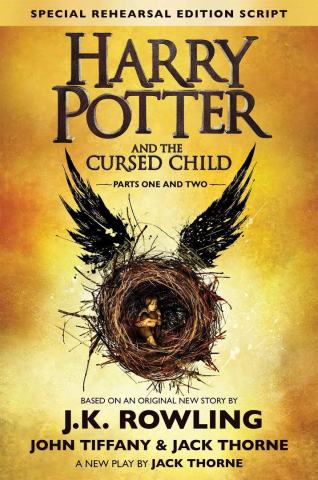
I finally read Harry Potter and the Cursed Child (Parts One and Two). Finished it today, in fact. This isn’t going to be a long or particularly detailed review, but there were some particulars I wanted to mention about the book.
First impressions overall, I thought the book was good. I went into it basically only having the short review of the friend who lent me their copy of the book, and who rated it a 2.5 out of 5. So, I had a cautious and skeptical approach to the book as I opened the cover to begin reading. But that slipped away, and I found myself no longer paying attention to time as I flipped page after page.
There are spoilers ahead, so if you don’t want those, stop reading and come back later.
One of the things I enjoyed about the book was how certain elements clued in from the beginning was woven into the solutions and eurekas at the climax and near the end. Granted, that’s a pretty standard storytelling technique, but particular moments like with Harry Potter’s baby blanket became nice illustrations of that technique.
I sometimes think time travel (as in plots that involve the act of traveling in time, not the act of creating prequels) is an easy answer to recycling a good series, but that didn’t stop me from still finding some enjoyment in this book. That said, I’m squinting my eyes hard at more and more popular series/stories recycling old plots or content through the instrument of time travel. I hope that it doesn’t become an apparatus so commonplace that it becomes boring or predictable. I like time travel stories, but I don’t like seeing it becoming a cashcow opportunity.
So far as the plot of HP#8, it definitely seemed to me to be much more about the relationships between Harry Potter and his son Albus, as well as Albus and his friend Scorpius Malfoy, than about the second rising of Voldemort, even though that was used as a vehicle for the relationship plots. And I liked that. Bringing back Voldemort would be quite a bit boring and would have appeared like the writers were just returning to material “that worked before” rather than trying to reinvent something more fresh.
That said, there are times I was not entirely sold that the reason Harry and Albus had such a tense relationship was because Albus was concerned about living up to the Potter name, worried about disappointing his dad, jealousy, and embarrassment. I realize that’s what they were going for, but throughout the book you are more or less told this like “hey guys, this is the reason they are not getting along.” And there could have been an even deeper build and more complex background to the tension that Harry and Albus share than the usual “my dad is famous and I’m a nobody loser.” And near the end, it got really Lion King-y with the whole son: “I thought you were never afraid,” father: “There were many times I have been afraid. / Even great heroes can be afraid. / I was very afraid because I thought I was going to lose you” stuff.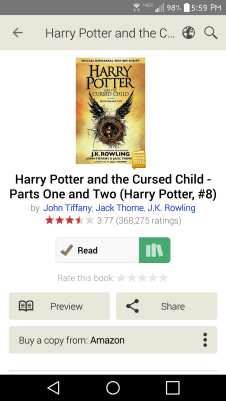
Generally, I enjoyed the transitions in the book, and watching them play out in my head made for some pretty poignant visuals, and I can sort of imagine how the lighting and staging could make this pretty powerful.
After reading it, I went over to my Goodreads app to log it. The rating from the 300k+ people who have rated it on the app is exactly the right rating for this book. 3.77 out of 5.
 Game Mechanics